In the
March 1853 and
August 1853 installments of Scenes Beyond the Western Border, we found Philip St George Cooke (more likely, his ghostwriter) preoccupied with language and arguments that had been forcefully employed by
critics of Melville's latest book,
Pierre (1852).
The year before, the August 1852 featured a similar kind of episode, wherein the writer has oddly and imaginatively expanded the narrative using language employed by critics of Melville's previous book.
Yep, that would be
Moby-Dick (1851).
June 22d.—Independence Rock.—Yesterday, we forded and left the Platte, to turn confused masses of mountains with picturesque red-rock precipices, which there begin to wall it in; it is called the Red But[t]es. We passed one spring, with a little grass, about half way of our march of twenty seven miles to another. The last half was the most desolate and wild region we had seen: high plains where there was nothing but clay or sand, and a few stunted, dusty artemisias, interspersed with great rock-hills of dark volcanic appearance. We had to dispute possession with buffalo of the small well-cropped oasis where we encamped, and with another grizzly bear, which we routed out, at dusk, after it had greatly alarmed the horses.
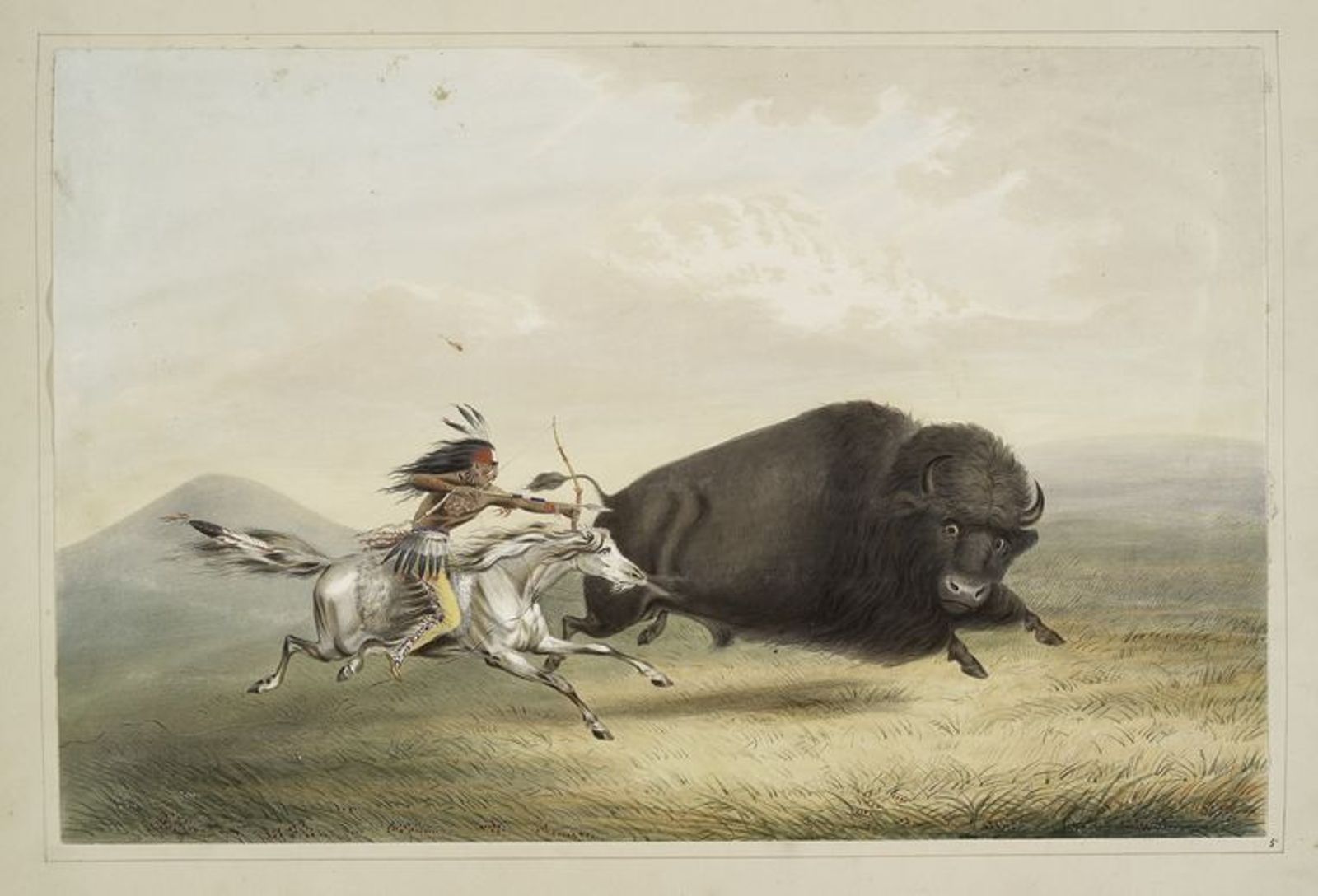
About 5 o'clock, this morning we were in the saddle, anxious—with the famed Sweet Water for our goal—to finish the remaining twenty-five miles of desert. We passed several springs, with a little grass, bog, and some plum bushes; as we neared the river, the country grew more wildly barren; there was a great plain of white sand, and, here and there, of glittering Epsom Salts! Amid the mirage and white dust, and the dizzy glow of reflected light and heat, which nearly turned the brain, I have still in my mind's eye a kind of vision of the indomitable hunter, Capt. M., scudding over far black slopes, which seemed themselves in wavy motion, fiercely pursuing flying buffaloes: it was a rivalry of all the German extravagance of their favorite legend of the wild huntsman. The facts seem simple, but there was an unnatural strangeness, a suffocating, alarming heat in the dazzling plains, and the black hills, that gave a dreamy confusion and doubt to realities. Did then, the strange mirage cheat the senses with apparitions of a desperate hunter, on that wonderful gray horse, pursuing black monsters, far, far and indistinctly into the glowing haze?
After all, we knew it was Ben. Moore,* or the devil! But it had always been said that he would follow a buffalo to the abode—left to that imagination which here seemed realized.
Scenes Beyond the Western Border, August 1852; and
Scenes and Adventures in the Army
Ostensibly Benjamin Moore, the intrepid "Capt. M." is portrayed as an Ahab-like "indomitable hunter." Weirdly, the writer compares the real buffalo chase to overblown German romance: "it was a rivalry of all the German extravagance of their favorite legend of the wild huntsman." Just so did critics complain of Melville's "extravagance" and unduly strong German influences in
Moby-Dick.
Harrison Hayford pointed out the critique of German influences most eloquently:
"... Melville's contemporary reviewers right away recognized his German streak. They recognized it, named it, and deplored its presence in Mardi, Moby-Dick, and Pierre... (Melville's German Streak)
As Hayford notes, Evert Duyckinck likened Ahab to Faust, and parts of
Moby-Dick to "Jean Paul's German tales," meaning the romances of
Jean-Paul Richter. On 22 November 1851, the New York
Tribune reviewer characterized Ahab's quest as a "wild huntsman's chase"
(Contemporary Reviews).
Literary treatments of the Wild Huntsman legend include Irving's tale of
Sleepy Hollow,
Scott's poem (from
Der wilde Jäger, the ballad by
Gottfried August Bürger) and adaptations of the opera
Der Freischütz. "The English version of Weber's opera of "Der Freyschutz" was first performed in America in March 1825
(Records of the New York Stage).
"Capt. M." shows off his "extravagance" in the buffalo hunt; likewise the London
Atlas explicitly and repeatedly criticized Melville for his
"besetting sin of extravagance."
Extravagance is the bane of the book, and the stumbling
block of the author. He allows his fancy
not only to run riot, but absolutely to run amuck…. Mr. Melville is endowed
with a fatal facility for the writing of rhapsodies. Once embarked on a flourishing topic, he
knows not when or how to stop. He flies over the pages as Mynheer Von Clam flew
over Holland on his steam leg, perfectly powerless to control the impulse which
has run away with him, and leaving the dismayed and confounded reader panting far
behind.
... And this
unbridled
extravagance in writing, this listless and profitless
dreaming, and maundering with
the pen in the hand, is as it were supported and backed by the
wildness of
conception and
semi-supernatural tone of the whole story.
(Contemporary Reviews)
Ahab is nothing if not indomitable--as is the White Whale he hunts. OK then, Ahab is humanly indomitable. In
chapter 33 of Moby-Dick Melville reveals the dramatic aim of Ishmael as the effort "to depict
mortal indomitableness in its fullest sweep and direst swing."
Capt. M's buffalo chase is described as the pursuit of "black monsters," recalling the frequent characterization in Moby-Dick of whales as monsters:
It would be refining too much, perhaps, even considering his monomania, to hint that his vindictiveness towards the
White Whale might have possibly extended itself in some degree to all
Sperm Whales, and that the more monsters he slew by so much the more he
multiplied the chances that each subsequently encountered whale would
prove to be the hated one he hunted. (Power Moby-Dick)
Something else about the chase after "flying buffaloes" as a literary quest. The same conceit, writing as the hunting of wild animals, occurs in one of Melville's
manuscript poems about
the poet Camões:
The world with endless beauty teems,
And thought evokes new worlds of dreams:
Hunt then the flying herds of themes!


.jpg)