Did you hear of the _______? by Scott Norsworthy
A shared 5-gram in "Scenes Beyond the Western Border" and Herman Melville's "The Lightning-Rod Man"
Read on Substack

Inspired by recent encounters with Hawthorne, in particular by their heady and hearty barn-talk that March, Melville might have found a way to get the gist of their stimulating conversations into print. Echoes of Melville’s letters in the opening installment of “Scenes Beyond the Western Border” lead me to suspect it may be haunted by Hawthorne. At any rate, coincidence or no, the narrator of “Scenes Beyond the Western Border” talks to the reader like Melville talked in letters to Hawthorne. Here’s one example from the first of Melville’s Agatha letters to Hawthorne dated August 13, 1852.24
In this example, wording and structure of the Captain’s pledge to do most of the talking for his singular reader match the “and if / why I” construction in Melville's 1852 letter to Hawthorne (emphasis mine):“… and if you are absolutely dumb, why I will sometimes answer for you.”
“And if I thought I could do it well as you, why, I should not let you have it.”
https://archive.org/details/in.ernet.dli.2015.84865/page/n197/mode/2up
Introducing likely topics of conversation, the Captain sounds quite like Melville when promising a good time to his invited guest:
MELVILLE
“Hark— There is some excellent Montado Sherry awaiting you & some most potent Port. We will have mulled wine with wisdom, & buttered toast with story-telling & crack jokes & bottles from morning till night.”
— Letter to Nathaniel Hawthorne, 29 January? 1851; emphasis mine.CAPTAIN
“We will talk on all subjects, from the shape of a horse-shoe to that of the slipper of the last favorite—say the 'divine Fanny,’ from great battles, or Napier's splendid pictures of such, down to the obscurest point of the squad drill—from buffalo bulls to elfin sprites.”
—Scenes Beyond the Western Border, June 185125These elaborate invites are similarly themed and structured. Each presents an inventory of delightful activities in store for the recipient, each inventory being divided in three main parts. Melville’s three groupings of promised events are separated by three ampersands; the Captain’s by the word from, used thrice. The invitation in each case extends to just one person: Melville to Hawthorne, the Captain to his Imaginary Friend the reader. The plural “We” brings together speaker and singular reader as joint enjoyers of good times ahead, chiefly to be spent in stimulating conversation....
What "you must take" in both cases is somebody's creative writing: Hawthorne's book of short stories and the narrator's unexpected burst into verse.
Take these raspberries, and then I will give you some moss."—"Moss!" said I—"Yes, and you must take it to the barn with you, and good-bye to 'Dwight.'"
--The Literary World Volume 7 (August 17, 1850) page 125.

How dreary must be a great Commodore ,
Alone in the cabin of a seventy-four.
Be not alarmed ! I make a rhyme but once a year ; the idea came in that shape , and you must take it as it comes .
-- Southern Literary Messenger Volume 17 (June 1851) page 372; and Scenes and Adventures in the Army (Philadelphia, 1857) page 228.
Among other significant changes the word buoyant was added in revision of the August 1852 dialogue in Scenes Beyond the Western Border between the narrating Captain of U. S. Dragoons and "Frank," his imaginary friend. As revised in Part II of Scenes and Adventures in the Army (1857), the narrator feels "buoyant and bitter," elevated in spirit by the "wild mountain air" near Devil's Gate and the South Pass of the Rockies.
"I am only in a mood; buoyant and bitter; tameless as the Arab coursing his native desert; free as yonder soaring eagle! it's this wild mountain air!"
| Scenes and Adventures in the Army (1857) page 355 |
| Southern Literary Messenger August 1852 |
F. “When I have you committed, fairly pinned in contradiction, you fly off into a maze of extravagant fancies, where I should be lost as well, if I followed.”
C. “And get the best of it! Ah! my good friend, let this wild mountain air have fair play; let us with the desert's freedom joyously flout convention and opinion—upstart usurpers!—let us make mocking sport of the prosaic solemnity of ignorant prejudice;—let us shoot popguns at least, against the solid bulwarks where folly and selfishness sit enthroned!"
F. “Then fire away!—though hang me if I know what you mean.”
Scenes Beyond the Western Border - August 1852
https://books.google.com/books?id=-AkNAQAAIAAJ&pg=PA508&dq#v=onepage&q&f=false
"Possibly, the vexation might have been something different, were it not for the buoyant confidence inspired by the breeze."
https://books.google.com/books?id=i_FIAAAAcAAJ&pg=PA472&dq#v=onepage&q&f=false
But the book version in The Piazza Tales (1856) replaces buoyant with brisk, thus:
"Possibly, the vexation might have been something different, were it not for the brisk confidence inspired by the breeze."
https://archive.org/details/piazztales00melvrich/page/222/mode/2up
 |
| Winter pine tree draped in snow. William S. Keller, 1979. via National Park Service |
 |
| Buffalo Bull, Grazing on the Prairie. George Catlin. Smithsonian American Art Museum |
... wonderful it was to think that a bull, after being wounded and stunned by a twelve-pound shell, should rush upon a great column of horse, and heedless of a hundred shots and twenty wounds, with a bull-dog to his lip, should toss a horse and rider like a feather.... -- Scenes Beyond the Western Border, September 1851; and Scenes and Adventures in the Army, pages 260-261.
| Southern Literary Messenger - September 1851 |
... the White Whale churning himself into furious speed, almost in an instant as it were, rushing among the boats with open jaws, and a lashing tail, offered appalling battle on every side; and heedless of the irons darted at him from every boat, seemed only intent on annihilating each separate plank of which those boats were made. -- Moby-Dick chapter 134, The Chase—Second Day.The word heedless does not appear in the source-text for the affair of the death-defying buffalo, the entry for June 28th in Philip St. George Cooke's 1843 Journal of the Santa Fe Trail. Transcribed by William E. Connelley in The Mississippi Valley Historical Review Vol. 12, No. 1 (June 1925), pages 72-98; and Vol. 12, No. 2 (September 1925), pages 227-255. For Cooke's 1843 journal in manuscript, see National Archives Letters Received by the Office of the Adjutant General 1822-1860 / 1843 / C / Cooke, P St G / C252; available online via fold3.
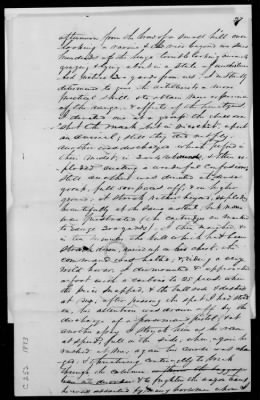
June 28th [1843]
... the command was halted, and riding a very wild horse, I dismounted and approached on foot with a carbine to 25 paces, when the piece snapped, and the bull rose and dashed at me; after passing the spot I had stood on, his attention was drawn off by the di[s]charge of a horseman's pistol; and at another essay I struck him as he ran at speed, full in the side; when, again he rushed at me; again his course was changed; and threatening continually to break through the column, and to frighten the wagon teams he was assailed by many horsemen whom I did not wish to restrain; pistol and carbine shots increased every moment and the frightened horses rendered them dangerous; it seemed a confused action; a doubtful battle: after falling with a great shock, the beast arose and attacked a mounted corporal: tossed his horse like a plaything, goring him in two places: the corporal fell headlong on the bull's horns, his pistol discharged at the same instant, the ball passed through his horse's neck, which then ran off frantically: the man was borne, hanging by his clothes on the horns, for several leaps: a bull dog seized the monster by the lip, and all fell into a confused heap; we next through the dust saw the corporal scrambling desperately from the melee, having wonderfully escaped from injury; the deathless animal again rose, and shook his black and shaggy front, in defiance: then many deliberate carbine shots were fired at him: and he fell and rose repeatedly —while lying down carbine balls were fired with deliberate aim at 10 paces, seemingly without effect: when finally I sent one through the eye into his brain — the shell had broken the shoulder blade. The animal died, and has been eaten; the horse is doing well.
(William E. Connelley, ed., A Journal of the Santa Fe Trail in The Mississippi Valley Historical Review Vol. 12, No. 1 (June 1925), page 97.)Cooke seems to have regretted the breezy treatment of this episode in the magazine and book versions of Scenes and Adventures in the Army. The rewrite condensed the graphic account he had written in his 1843 army journal, incorporating a summary of the affair into one of the ongoing dialogues between the narrating captain and his "Imaginary Friend." Decades later, Cooke managed to get most of the original version into print, when The United States Army and Navy Journal published his letter to the editor under the title, An American "Bull Fight." From The United States Army and Navy Journal, April 8, 1882, page 819:
To the Editor of the Army and Navy Journal:
SIR: I have been delving into the MS. of an old official journal and have found verbal daguerrotypes of some scenes which your readers may find racy, despite their age. Of course they might receive more polished expression, but it would be almost a pity to alter a hue of a picture freshly drawn from nature.
We all have read, ad nauseum, of Spanish bull fights, when the poor beast is cornered and nearly every thing prearranged, but here you find a tolerably fair fight between a valiant buffalo and some two hundred “ horse, foot, and " — artillery. Place, Upper Arkansas; time, June, 1843.
“For six miles we marched through one village of ‘prairie dogs,’ whose shrill barking was incessantly sounding in our cars; but their strange antics scarcely attracted attention when thousands of buffalo, dotting the visible world far and near, were the whole day seen around us; each moment shifting views of chases by officers or traders, fixing the attention with a new interest. In the afternoon from the brow of a small hill we suddenly came in view of hundreds of the huge savage looking animals, grazing and lying about in the most natural manner, only three hundred paces from us. I instantly determined to give the artillerists some desired practice, and to get some experience of the range and effects of the mountain howitzer shells. I directed one myself at a group; the shell passed over it, but in ricochet upset one animal. Another was discharged which passed in their midst in three or four rebounds, and then exploded, creating a wonderful confusion. Still another was directed at a dense group, full five hundred paces off, and on higher ground; it struck rather beyond, exploding beautifully at the same instant, but none were prostrated. I then marched on (rather disgusted in truth with mountain howitzers). In a few minutes, as we approached the bull which had been struck, he raised himself up on his chest; the command was halted. Being mounted on a very wild horse I dismounted and approached him afoot to twenty-five paces, aimed and snapped my carbine. Then the bull rose and rushed at me. After passing the spot I had stood on, his attention was diverted to a horseman and his pistol shot; a moment after, as he was charging past me, I fired and struck him in his side; again he turned and pursued me until his course was changed to a new enemy. The bull seemed set to break through the column; and the baggage train mules, which had come close up, were turning short and trying to run. He was assailed now by many horsemen with a free discharge of pistol shots from riders of prancing horses; it was like a confused and doubtful melee.
“ After falling with a great shock, the bull rose and charged a mounted corporal, tossed his horse like a plaything, goring him in two places; the corporal fell headlong, his pistol at the same instant going off, and the ball passing through his horse‘s neck, which then ran off; but the corporal was caught on a horn, only by his clothes, fortunately, and was thus borne by the bull for several leaps; but a new actor appeared, a bulldog: and he caught the buffalo by his under lip, and then all fell in a confused heap. Next from out the cloud of dust the corporal was seen, desperately scrambling on hands and knees. The deathless animal again rose, and shook at us his shaggy front in defiance. Then many deliberate carbine shots were fired into him, and he fell and rose repeatedly; some were fired close by while he lay, but seemed to have no effect. Finally, I sent a ball through an eye to his brain. The shell had broken a shoulder blade.
“ The poor bull died, and has been eaten—in defiance of nightmare!”
P. St. G. Cooke, U. S. A.
https://books.google.com/books?id=Xvg-AQAAMAAJ&pg=PA819&dq#v=onepage&q&f=falseIn a footnote to his 1925 edition of Cooke's Santa Fe journal, William E. Connelley remarks:
"This is the first instance known to this editor where the buffalo was hunted with artillery and killed with explosive shells fired from cannon."Another editor, Joseph Macaulay Lowe was more sympathetic to the defiant buffalo:
"(If the writer of this book had have been in command, we would have erected a monument to this gallant foe. — Ed.)" -- The National Old Trails Road (Kansas City, 1925) page 110.Lowe called this episode, "The Strangest Battle in History." Cooke again referenced his firsthand narrative of the defiant buffalo bull in A Day's Work of a Captain of Dragoons, published in The United States Army and Navy Journal on July 1, 1882, pages 1106-1107.
https://books.google.com/books?id=Xvg-AQAAMAAJ&pg=PA1106&lpg#v=onepage&q&f=falseRelated post:
"Ah! how very doleful is that plaint! Never, never the doleful!"
--from Scenes Beyond the Western Border (August 1852); and (slightly revised) in Scenes and Adventures in the Army.
The revised 1857 version switches prepositions in and with: calm "with which" revised to calm "in which"; "in fairy creations" then becomes "with fairy creations."
Scenes Beyond the Western Border
Southern Literary Messenger 18 (August 1852): 506
It is near midnight. Silence reigns in the desert; but now and then come the cries of wolves from the mountains. They give an almost supernatural tone to these solemn solitudes. The repose which twenty hours of excitement and toil demand, is banished. Hark! how they howl! Be grandly dreary, and ye will be attuned to the heart! Yes, never better to a sentimental girl the gentlest breathings of an AEolian harp. Ah! how very doleful is that plaint! Never, never, the doleful! Give me the placid calm in which the soul may revel with fairy creations, adorned by all the flowers of thought—or proud action, the storm of wild and passionate will. The gilded and painted memory, or fierce oblivion.
“Great God! but for one single instant show thyself,” cried Starbuck; “never, never wilt thou capture him, old man— --Chapter 134, The Chase—Second Day.PIERRE (1852)
Then, swear to me, dear Pierre, that thou wilt never keep a secret from me—no, never, never;—swear!" 1852 first edition, page 49
Nay, nay, groaned Pierre, never, never, could such syllables be one instant tolerated by her. --page 120
And Pierre felt that never, never would he be able to embrace Isabel with the mere brotherly embrace; --page 193In the same passage from Scenes Beyond the Western Border (August 1852) with "Never, never", the figurative AEolian harp communicates a "plaint" described as "doleful"; in Pierre; Or, The Ambiguities (first published at the end of July 1852), Isabel's guitar voices her "melancholy plaints":
But the wonderful melodiousness of her grief had touched the secret monochord within his breast, by an apparent magic, precisely similar to that which had moved the stringed tongue of her guitar to respond to the heart-strings of her own melancholy plaints. --Page 234THE PIAZZA (1856)
"Oh, sir," tears starting in her eyes, "the first time I looked out of this window, I said 'never, never shall I weary of this.'" --first story in Melville's The Piazza Tales
 |
| Bogard, Batiste, and I Chasing Buffalo in High Grass on a Missouri Bottom. George Catlin via Wikimedia Commons |
Pierre little foresaw that this world hath a secret deeper than beauty, and Life some burdens heavier than death.
"Well, life's a burden, they say; why not be burdened cheerily?"
--Pierre; Or, The AmbiguitiesSCENES BEYOND THE WESTERN BORDER (APRIL 1852)
An hour—almost of happiness—passes, and we take up our burdens and part forever!
I. F. [Imaginary Friend] ... Your 'almost happiness!' — and 'burden,' of life did you mean? for I never saw one lighter mounted on a finer horse!
| Southern Literary Messenger - April 1852 |
Friend. ... Your "almost happiness!"— and "burden," of life did you mean? for I never saw one lighter mounted on a finer horse! --Scenes and Adventures in the Army
With what strange complacency ....
--August 1853 installment of Scenes Beyond The Western Border; and Scenes and Adventures in the Army.MOBY-DICK (1851)
with what wondrous habitude of unconscious skill the whaleman will maintain an erect posture in his boat --The First Lowering
with what prodigious fury the Bashaw assails him, and chases him away! --Schools and Schoolmasters
See with what entire freedom the whaleman takes his handful of lamps --The Lamp
thereby intimating with what deep reverence his portrait would be handled
For he considered with what infinite readiness now, the most faithful portrait of any one could be taken by the Daguerreotype....
With what marvelous precision and exactitude he now went over in his mind all the minutest details of his old joyous life with his mother at Saddle Meadows.In the August 1853 episode, the final installment of Scenes Beyond the Western Border, the narrator's imaginary traveling companion "Frank" quotes well known lines from James Thomson's The Seasons - Summer, slightly altered ("their minds" replacing Thomson's "her mind" or "his mind" in some anthologies).
— ' the smallest part
Exceeds the narrow visions of their minds.' "
And who lives that blasphemes? --Mardi: And a Voyage ThitherThe narrator of "Scenes Beyond the Western Border" (the 1851-1853 magazine series, reprinted with later revisions as Part II of Scenes and Adventures in the Army):
But who lives, who may not be wounded through another! --August 1852 Scenes Beyond the Western Border; and Scenes and Adventures in the ArmyApemantus:
... Who lives, that's not
Depraved or depraves? Who dies, that bears
Not one spurn to their graves of their friends' gift? --Timon of Athens, Act 1 Scene 2
"True, Shakespeare goes further. None die but somebody spurns them into the grave."True or false, friendship in the material world ends with death and burial. Bruyère's theme of temporal, conditional friendship, amplified by Shakespeare according to Melville, gets remarkably close to the essence of the narrator's lament in the August 1852 installment of "Scenes Beyond the Western Border." The narrating "Captain of U. S. Dragoons" continues in the Timon vein normally employed by Frank, his cynical traveling companion:
--quoted in Hershel Parker, Herman Melville: A Biography, Vol. 2, 1851-1891 (Johns Hopkins University Press, 2002), page 502.
I dare say, nay, I am sure, that beyond some family ties, there is not upon the wide earth a heart in sympathy with our good or ill; whose even beat would be as much disturbed, were this wild sod to cover us forever, as the most ephemeral of the trifling cares which make up their petty lives."Eventually our Captain recovers his romantic self, however. Ready to embrace Illusion over intolerable Truth, exemplifying the "heroism" of "blind credulity," he eloquently urges belief in
"a pure soul love, — a deathless friendship, which all life's trials and worldly baseness cannot soil or sap."
 |
| Table of Contents - Scenes and Adventures in the Army |
CHAPTER XVIII.
Romantic Cheyenne Village — Adventures There — Our Few Wants Unsupplied in the Wilderness — March Without Water.... --Contents, part 2 chapter 18 of Scenes and Adventures in the Army (Philadelphia: Lindsay & Blakiston, 1857).
The shores of the Straits of Sunda are unsupplied with those domineering fortresses which guard the entrances to the Mediterranean, the Baltic, and the Propontis.--Chapter 87, The Grand Armada
But here a curious difficulty presented itself. In the excitement of the moment, Ahab had forgotten that since the loss of his leg he had never once stepped on board of any vessel at sea but his own, and then it was always by an ingenious and very handy mechanical contrivance peculiar to the Pequod, and a thing not to be rigged and shipped in any other vessel at a moment's warning. Now, it is no very easy matter for anybody—except those who are almost hourly used to it, like whalemen—to clamber up a ship's side from a boat on the open sea; for the great swells now lift the boat high up towards the bulwarks, and then instantaneously drop it half way down to the kelson. So, deprived of one leg, and the strange ship of course being altogether unsupplied with the kindly invention, Ahab now found himself abjectly reduced to a clumsy landsman again; hopelessly eyeing the uncertain changeful height he could hardly hope to attain. --Chapter 100, Leg and Arm
What would become of a Greenland whale, say, in those shuddering, icy seas of the North, if unsupplied with his cosy surtout? --Chapter 68, The Blanket
Instantly the music changed.... --Pierre: Or, The Ambiguities (1852)
| Southern Literary Messenger - May 1853 |
But soon, the music changed; and, stranger then and there, to a sweet waltz! --May 1853 Scenes Beyond the Western Border; and Scenes and Adventures in the Army (with "sweet waltz" revised to "joyous air").
| Scenes and Adventures in the Army (1857) - page 409 |
... life is little else than an often interrupted and luxurious nap. --Typee
And why not tell my dream?—Life is little better; nay, it is little different. --March 1853 Scenes Beyond the Western Border; and Scenes and Adventures in the Army.

