Remaking "Oregon, Ho!" in prose and dialogue by Scott Norsworthy
DRAGOONED: Writing, talking, and rewriting like Herman Melville in "Scenes Beyond the Western Border" (1851-1853). Number 9.
Read on Substack

Inspired by recent encounters with Hawthorne, in particular by their heady and hearty barn-talk that March, Melville might have found a way to get the gist of their stimulating conversations into print. Echoes of Melville’s letters in the opening installment of “Scenes Beyond the Western Border” lead me to suspect it may be haunted by Hawthorne. At any rate, coincidence or no, the narrator of “Scenes Beyond the Western Border” talks to the reader like Melville talked in letters to Hawthorne. Here’s one example from the first of Melville’s Agatha letters to Hawthorne dated August 13, 1852.24
In this example, wording and structure of the Captain’s pledge to do most of the talking for his singular reader match the “and if / why I” construction in Melville's 1852 letter to Hawthorne (emphasis mine):“… and if you are absolutely dumb, why I will sometimes answer for you.”
“And if I thought I could do it well as you, why, I should not let you have it.”
https://archive.org/details/in.ernet.dli.2015.84865/page/n197/mode/2up
Introducing likely topics of conversation, the Captain sounds quite like Melville when promising a good time to his invited guest:
MELVILLE
“Hark— There is some excellent Montado Sherry awaiting you & some most potent Port. We will have mulled wine with wisdom, & buttered toast with story-telling & crack jokes & bottles from morning till night.”
— Letter to Nathaniel Hawthorne, 29 January? 1851; emphasis mine.CAPTAIN
“We will talk on all subjects, from the shape of a horse-shoe to that of the slipper of the last favorite—say the 'divine Fanny,’ from great battles, or Napier's splendid pictures of such, down to the obscurest point of the squad drill—from buffalo bulls to elfin sprites.”
—Scenes Beyond the Western Border, June 185125These elaborate invites are similarly themed and structured. Each presents an inventory of delightful activities in store for the recipient, each inventory being divided in three main parts. Melville’s three groupings of promised events are separated by three ampersands; the Captain’s by the word from, used thrice. The invitation in each case extends to just one person: Melville to Hawthorne, the Captain to his Imaginary Friend the reader. The plural “We” brings together speaker and singular reader as joint enjoyers of good times ahead, chiefly to be spent in stimulating conversation....
Among other significant changes the word buoyant was added in revision of the August 1852 dialogue in Scenes Beyond the Western Border between the narrating Captain of U. S. Dragoons and "Frank," his imaginary friend. As revised in Part II of Scenes and Adventures in the Army (1857), the narrator feels "buoyant and bitter," elevated in spirit by the "wild mountain air" near Devil's Gate and the South Pass of the Rockies.
"I am only in a mood; buoyant and bitter; tameless as the Arab coursing his native desert; free as yonder soaring eagle! it's this wild mountain air!"
| Scenes and Adventures in the Army (1857) page 355 |
| Southern Literary Messenger August 1852 |
F. “When I have you committed, fairly pinned in contradiction, you fly off into a maze of extravagant fancies, where I should be lost as well, if I followed.”
C. “And get the best of it! Ah! my good friend, let this wild mountain air have fair play; let us with the desert's freedom joyously flout convention and opinion—upstart usurpers!—let us make mocking sport of the prosaic solemnity of ignorant prejudice;—let us shoot popguns at least, against the solid bulwarks where folly and selfishness sit enthroned!"
F. “Then fire away!—though hang me if I know what you mean.”
Scenes Beyond the Western Border - August 1852
https://books.google.com/books?id=-AkNAQAAIAAJ&pg=PA508&dq#v=onepage&q&f=false
"Possibly, the vexation might have been something different, were it not for the buoyant confidence inspired by the breeze."
https://books.google.com/books?id=i_FIAAAAcAAJ&pg=PA472&dq#v=onepage&q&f=false
But the book version in The Piazza Tales (1856) replaces buoyant with brisk, thus:
"Possibly, the vexation might have been something different, were it not for the brisk confidence inspired by the breeze."
https://archive.org/details/piazztales00melvrich/page/222/mode/2up
 |
| Buffalo Bull, Grazing on the Prairie. George Catlin. Smithsonian American Art Museum |
... wonderful it was to think that a bull, after being wounded and stunned by a twelve-pound shell, should rush upon a great column of horse, and heedless of a hundred shots and twenty wounds, with a bull-dog to his lip, should toss a horse and rider like a feather.... -- Scenes Beyond the Western Border, September 1851; and Scenes and Adventures in the Army, pages 260-261.
| Southern Literary Messenger - September 1851 |
... the White Whale churning himself into furious speed, almost in an instant as it were, rushing among the boats with open jaws, and a lashing tail, offered appalling battle on every side; and heedless of the irons darted at him from every boat, seemed only intent on annihilating each separate plank of which those boats were made. -- Moby-Dick chapter 134, The Chase—Second Day.The word heedless does not appear in the source-text for the affair of the death-defying buffalo, the entry for June 28th in Philip St. George Cooke's 1843 Journal of the Santa Fe Trail. Transcribed by William E. Connelley in The Mississippi Valley Historical Review Vol. 12, No. 1 (June 1925), pages 72-98; and Vol. 12, No. 2 (September 1925), pages 227-255. For Cooke's 1843 journal in manuscript, see National Archives Letters Received by the Office of the Adjutant General 1822-1860 / 1843 / C / Cooke, P St G / C252; available online via fold3.
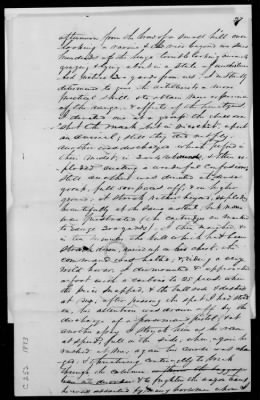
June 28th [1843]
... the command was halted, and riding a very wild horse, I dismounted and approached on foot with a carbine to 25 paces, when the piece snapped, and the bull rose and dashed at me; after passing the spot I had stood on, his attention was drawn off by the di[s]charge of a horseman's pistol; and at another essay I struck him as he ran at speed, full in the side; when, again he rushed at me; again his course was changed; and threatening continually to break through the column, and to frighten the wagon teams he was assailed by many horsemen whom I did not wish to restrain; pistol and carbine shots increased every moment and the frightened horses rendered them dangerous; it seemed a confused action; a doubtful battle: after falling with a great shock, the beast arose and attacked a mounted corporal: tossed his horse like a plaything, goring him in two places: the corporal fell headlong on the bull's horns, his pistol discharged at the same instant, the ball passed through his horse's neck, which then ran off frantically: the man was borne, hanging by his clothes on the horns, for several leaps: a bull dog seized the monster by the lip, and all fell into a confused heap; we next through the dust saw the corporal scrambling desperately from the melee, having wonderfully escaped from injury; the deathless animal again rose, and shook his black and shaggy front, in defiance: then many deliberate carbine shots were fired at him: and he fell and rose repeatedly —while lying down carbine balls were fired with deliberate aim at 10 paces, seemingly without effect: when finally I sent one through the eye into his brain — the shell had broken the shoulder blade. The animal died, and has been eaten; the horse is doing well.
(William E. Connelley, ed., A Journal of the Santa Fe Trail in The Mississippi Valley Historical Review Vol. 12, No. 1 (June 1925), page 97.)Cooke seems to have regretted the breezy treatment of this episode in the magazine and book versions of Scenes and Adventures in the Army. The rewrite condensed the graphic account he had written in his 1843 army journal, incorporating a summary of the affair into one of the ongoing dialogues between the narrating captain and his "Imaginary Friend." Decades later, Cooke managed to get most of the original version into print, when The United States Army and Navy Journal published his letter to the editor under the title, An American "Bull Fight." From The United States Army and Navy Journal, April 8, 1882, page 819:
To the Editor of the Army and Navy Journal:
SIR: I have been delving into the MS. of an old official journal and have found verbal daguerrotypes of some scenes which your readers may find racy, despite their age. Of course they might receive more polished expression, but it would be almost a pity to alter a hue of a picture freshly drawn from nature.
We all have read, ad nauseum, of Spanish bull fights, when the poor beast is cornered and nearly every thing prearranged, but here you find a tolerably fair fight between a valiant buffalo and some two hundred “ horse, foot, and " — artillery. Place, Upper Arkansas; time, June, 1843.
“For six miles we marched through one village of ‘prairie dogs,’ whose shrill barking was incessantly sounding in our cars; but their strange antics scarcely attracted attention when thousands of buffalo, dotting the visible world far and near, were the whole day seen around us; each moment shifting views of chases by officers or traders, fixing the attention with a new interest. In the afternoon from the brow of a small hill we suddenly came in view of hundreds of the huge savage looking animals, grazing and lying about in the most natural manner, only three hundred paces from us. I instantly determined to give the artillerists some desired practice, and to get some experience of the range and effects of the mountain howitzer shells. I directed one myself at a group; the shell passed over it, but in ricochet upset one animal. Another was discharged which passed in their midst in three or four rebounds, and then exploded, creating a wonderful confusion. Still another was directed at a dense group, full five hundred paces off, and on higher ground; it struck rather beyond, exploding beautifully at the same instant, but none were prostrated. I then marched on (rather disgusted in truth with mountain howitzers). In a few minutes, as we approached the bull which had been struck, he raised himself up on his chest; the command was halted. Being mounted on a very wild horse I dismounted and approached him afoot to twenty-five paces, aimed and snapped my carbine. Then the bull rose and rushed at me. After passing the spot I had stood on, his attention was diverted to a horseman and his pistol shot; a moment after, as he was charging past me, I fired and struck him in his side; again he turned and pursued me until his course was changed to a new enemy. The bull seemed set to break through the column; and the baggage train mules, which had come close up, were turning short and trying to run. He was assailed now by many horsemen with a free discharge of pistol shots from riders of prancing horses; it was like a confused and doubtful melee.
“ After falling with a great shock, the bull rose and charged a mounted corporal, tossed his horse like a plaything, goring him in two places; the corporal fell headlong, his pistol at the same instant going off, and the ball passing through his horse‘s neck, which then ran off; but the corporal was caught on a horn, only by his clothes, fortunately, and was thus borne by the bull for several leaps; but a new actor appeared, a bulldog: and he caught the buffalo by his under lip, and then all fell in a confused heap. Next from out the cloud of dust the corporal was seen, desperately scrambling on hands and knees. The deathless animal again rose, and shook at us his shaggy front in defiance. Then many deliberate carbine shots were fired into him, and he fell and rose repeatedly; some were fired close by while he lay, but seemed to have no effect. Finally, I sent a ball through an eye to his brain. The shell had broken a shoulder blade.
“ The poor bull died, and has been eaten—in defiance of nightmare!”
P. St. G. Cooke, U. S. A.
https://books.google.com/books?id=Xvg-AQAAMAAJ&pg=PA819&dq#v=onepage&q&f=falseIn a footnote to his 1925 edition of Cooke's Santa Fe journal, William E. Connelley remarks:
"This is the first instance known to this editor where the buffalo was hunted with artillery and killed with explosive shells fired from cannon."Another editor, Joseph Macaulay Lowe was more sympathetic to the defiant buffalo:
"(If the writer of this book had have been in command, we would have erected a monument to this gallant foe. — Ed.)" -- The National Old Trails Road (Kansas City, 1925) page 110.Lowe called this episode, "The Strangest Battle in History." Cooke again referenced his firsthand narrative of the defiant buffalo bull in A Day's Work of a Captain of Dragoons, published in The United States Army and Navy Journal on July 1, 1882, pages 1106-1107.
https://books.google.com/books?id=Xvg-AQAAMAAJ&pg=PA1106&lpg#v=onepage&q&f=falseRelated post:
 |
| Bogard, Batiste, and I Chasing Buffalo in High Grass on a Missouri Bottom. George Catlin via Wikimedia Commons |
Pierre little foresaw that this world hath a secret deeper than beauty, and Life some burdens heavier than death.
"Well, life's a burden, they say; why not be burdened cheerily?"
--Pierre; Or, The AmbiguitiesSCENES BEYOND THE WESTERN BORDER (APRIL 1852)
An hour—almost of happiness—passes, and we take up our burdens and part forever!
I. F. [Imaginary Friend] ... Your 'almost happiness!' — and 'burden,' of life did you mean? for I never saw one lighter mounted on a finer horse!
| Southern Literary Messenger - April 1852 |
Friend. ... Your "almost happiness!"— and "burden," of life did you mean? for I never saw one lighter mounted on a finer horse! --Scenes and Adventures in the Army
... life is little else than an often interrupted and luxurious nap. --Typee
And why not tell my dream?—Life is little better; nay, it is little different. --March 1853 Scenes Beyond the Western Border; and Scenes and Adventures in the Army.
Suddenly, with a crash, as of a mountain of rock torn asunder.... --May 1853 Scenes Beyond the Western BorderRevisions to the May 1853 installment of "Scenes Beyond the Western Border" in the Southern Literary Messenger include deletion of the simile introduced with the expression, "as of a...." Cutting "as of a" transforms the metaphorical "mountain of rock" into literal "rocks," vividly re-figured after revision as "Titanic."
But suddenly, with a direful crash amid the Titanic rocks.... --Scenes and Adventures in the ArmyAlso added in revision, along with "Titanic": the adjective "direful" that describes the "crash" which has been made a more immediate and literal, less metaphorical sound, by deleting "as of a." Deleted or added, the verbal elements of this fascinating revision site are all exampled in Herman Melville's writing. The words direful and Titanic feature with particular significance in Moby-Dick (1851) and Pierre (1852), respectively.
And now, loud above the roar of the sea, was suddenly heard a sharp, splintering sound, as of a Norway woodman felling a pine in the forest. --Mardi: And A Voyage Thither
Touched by the breath of the bereaved Aurora, every sunrise that statue gave forth a mournful broken sound, as of a harp-string suddenly sundered, being too harshly wound. --Pierre; or, The AmbiguitiesDIREFUL
white curds of the whale's direful wrath --Moby Dick
Borean and dismasting blasts as direful as any that lash the salted wave; --The Town-Ho's Story
That direful mishap was at the bottom of his temporary recluseness.--Ahab's Legand once in Pierre; or, The Ambiguities:
not entirely untempered to human nature are the most direful blasts of Fate.TITANIC
a fearful pile of Titanic bricks
this Inferno of his Titanic vision.
the mountain once called Delectable, but now styled Titanic.
But now at last since the very blood in his body had in vain rebelled against his Titanic soul;
Such was the wild scenery—the Mount of Titans,Related post:
But now, "the morn is up again,"—and we have marched many miles fasting, and have been attracted through a turbid river by the sight of grass, and have stopped for breakfast under some cotton woods,—and in their shade I am scribbling with a pencil—Herman Melville, Redburn: His First Voyage
F.—"Yes, and fine work you are making of it! The day should commence with the morning, and the brighter the better; not with the nightmare of a sleeper, who should have watched."
C.—"Perhaps a nervous fit—from your strong coffee?"
... the fact was, his nerves could not stand it; in the course of his courtly career, he had drunk too much strong Mocha coffee and gunpowder tea, and had smoked altogether too many Havannas.White-Jacket chapter 83 A Man-of-War College
... owing to his partiality for strong coffee, he was apt to be nervous when we fired salutes....March 1853-Scenes Beyond the Western Border:
F.—"Now, listen to the song of that bird; it will soothe your nerves."The book version of this invented prairie dialogue drops all reference to nerves and coffee.
C.—"Nerves! It is medicine to the mind!—it comes like a message of love!"
July 7th.—But now, "the morn is up again," and we have marched many miles fasting, and have been attracted over the turbid river by the sight of grass, and have stopped and breakfasted under some cotton-woods; and in their shade my pipe and pencil are struggling for exclusive attention;—but pipe has it!—for here comes my sympathetic companion of the night, looking as discontented as if he had not been luxuriously talked to sleep.
"What's the matter?"
Friend.—O, confound the bivouac! the dew or frost has got into my joints.
"Delicate, indeed!"Herman Melville, 1849 journal entry:
Friend.—I believe this the very Valley of Acheron! in fact I had bad dreams,—of midnight incantations,— infernal revels.
"Pshaw! it was a calm and beautiful night; and never shone the stars through purer air, into the dark mountain vale. Listen to that sweet bird! it is piping now of some dream of love." --Scenes and Adventures in the Army
I impute the nightmare to a cup of prodigiously strong coffee...Herman Melville, Letter to Catherine Gansevoort Lansing (12 August 1878):
After two prodigious bumpers of coffee at the depot (from the effect of which I have hardly yet recovered)...
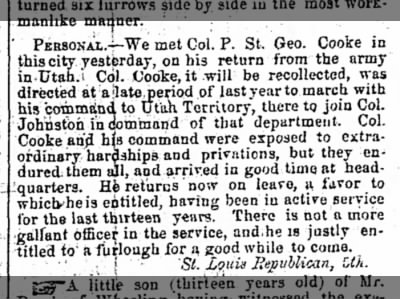
"I have one hundred and forty-four horses, and have lost one hundred and thirty-four. Most of the loss has occurred much this side of South Pass, in comparatively moderate weather. It has been of starvation. The earth has a no more lifeless, treeless, grassless desert; it contains scarcely a wolf to glut itself on the hundreds of dead and frozen animals which for thirty miles nearly block the road with abandoned and shattered property, they mark, perhaps, beyond example in history, the steps of an advancing army with the horrors of a disastrous retreat." --Philip St. George Cooke
 |
| Pittsfield Sun - February 4, 1858 |
 |
| via The New York Public Library Digital Collections |
Canes, laid on palm trunks, formed the floor. How elastic! In vogue all over Odo, among the chiefs, it imparted such a buoyancy to the person, that to this special cause may be imputed in good part the famous fine spirits of the nobles.
Hypochondriac! essay the elastic flooring! It shall so pleasantly and gently jolt thee, as to shake up, and pack off the stagnant humors mantling thy pool-like soul. Such was my dwelling.... --Mardi - Taji Retires from the WorldIn the July 1852 installment of "Scenes Beyond the Western Border" the collocation of gently with pleasantly occurs also in the context of a domestic retreat from "the world."
Whom then shall I address? — the mock sentimentalist? and begin the day: "Our slumbers this morning were gently and pleasantly dissolved by the cheerful martins, which sang a sweet reveille with the first blush of Aurora, at our uncurtained couches."
-- Scenes Beyond the Western Border, July 1852 ; and Scenes and Adventures in the Army, page 332.Melville's Taji "retires from the world" as announced in heading to chapter 62 in the first volume of Mardi. The Captain of U. S. Dragoons decides (after self-consciously experimenting with contrastive narrative modes, romantic or "sentimentalist" vs. politician, bureaucrat or "statist") that he would prefer a "friendly" reader in a "poetic mood" over "the shallow or hurried worldling." The sentence expressing this determination also appears without comment as sole epigraph to the 1857 book version:
"I address not then, the shallow or hurried worldling; but the friendly one, who in the calm intervals from worldly cares, grants me the aid of a quiet and thoughtful,—and if it may be,—a poetic mood." --July 1852 - Scenes Beyond the Western Border; epigraph in Scenes and Adventures in the Army.
How enviable is the Chian! Such is his simple, clean, comfortable house; so cheap, so moveable! When his summer carpet—of green velvet—wears out, how easy to move to another; to select some still pleasanter spring or valley, and enjoy the change of scene and air; free of the curses and the cares entailed by civilization. -- May 1853 - Scenes Beyond the Western Border; and Scenes and Adventures in the ArmyIn Pierre (1852) Melville uses the expression "summer carpet of green" when satirizing romanticized views of poverty:
Go to! God hath deposited cash in the Bank subject to our gentlemanly order; he hath bounteously blessed the world with a summer carpet of green. Begone, Heraclitus! The lamentations of the rain are but to make us our rainbows! --Pierre; Or, the AmbiguitiesAnd another thing, speaking of similar ways of praising domestic comforts in "Scenes Beyond the Western Border" and known writings by Herman Melville. The use of enviable by the dragoon-narrator to describe "the Chian" in his "clean, comfortable," inexpensive and portable home recalls Melville's use of the same adjective in praise of
" those enviable little tents or pulpits, called crow's-nests, in which the lookouts of a Greenland whaler are protected from the inclement weather of the frozen seas."Related post:
--Moby-Dick, chapter 35 - The Mast-Head
 |
| Image Credit: Raynors' Historical Collectible Auctions |
fugleman
"1. a trained soldier formerly posted in front of a line of soldiers at drill to serve as a model in their exercises...." --Merriam-WebsterFrom the Detroit Free Press, November 17, 1871:
The third regular toast, “The Army and Navy.” Responded to by Gen P. St. George Cooke, as follows:The book version prints a paragraph at the start of Cooke's response which does not appear in the newspaper transcript. There Cooke reveals that in 1863, he volunteered for duty in the Army of the Cumberland in a letter to General Rosecrans that strangely "miscarried." Nothing of Cooke's 1871 remarks before the Society of the Army of the Cumberland is recorded in Otis E. Young's classic biography, The West of Philip St George Cooke. However, the fate of that 1863 dead letter does illuminate Young's assessment of this unfortunate period in Cooke's career when "it is remarkable that Cooke had so little of an intra-service reputation that no officer requested his services in any capacity."
At the usual civic festivals this toast, as a compliment, calls only for an acknowledgment of thanks, and consequently of a brevity worth the approval of the highest authority, civil and military—to wit: of our present Commander in Chief of the Army and Navy. One who has realized a theory that in action is developed the supremest human triumphs; in speech next, and in writing third in order.
I adopt the theory—I embrace it with avidity; it should be a favorite with a profession, which, almost to a man, might say, with the great warrior Anthony, “I am no orator.”
We have in our land many soldiers now—many able officers—successful, many of them, in their professions and pursuits before their country’s extreme danger called them to arms; their ready response, as well as after distinction, proved them to have been of the elite; now again they are prominent citizens.
But that terrible war was a long one, and a fast school; for apt scholars there was time to learn that profession, and to develope not only thousands of volunteers into able, valuable officers, but some of them—as also regular officers—into commanding Generals. You are witnesses and proofs that such was the process, such the experience of the successful ones. Where now are those first Major Generals! I served under some of them, and tragic failures they were.
We could extemporize now a grand army, perhaps equal to any existing; but twenty years hence! How then! For the first year of a war—it is our experience—volunteers fall far short of the mark; and great wars are becoming short and sharp, counting only by months.
Our army, now reduced to 30,000 men, will again become the teachers of science and practice of war; the inventers, or lawful custodians of their improvements; and the fuglemen of the rank and file.
It is a thankless service; as patriots we pray for honorable peace; as soldiers we languish for professional excitement and promotion. But there’s the rub; when war comes the regulars have but small advancements; and, in truth, I think that long subordinate service—with the habit of mere obedience—cramps rather than developes capacities for command.
The regulars, with our volunteer policy, became the fly-wheel of that great helpless machine—an army of raw volunteers; they keep it a-going; the first motions are bad enough: but what would happen without some infusion of practical knowledge, and without the slowly acquired science of a very important number of them? And does it not sometimes happen that an influential politician turned General is borne along on the shoulders of some modest educated soldier of low rank?
But it is wonderful, when we consider the amount of duty performed and the various parts that are played by our small army. It can be found from the Tropic of Cancer to the Arctic Circle; from the Bay of Fundy to the Pacific shore. It defends frontiers from the tomahawk—which means, now, repeating arms in the hands of the Indians; it sometimes has to watch and control the mob in our great cities; it enforces the law and teaches civilization in some of the Southern States, and has begun, in strange alliance with the Quakers, much the same office for our red brethren.
We are sentinels—and scarcely more—on external frontiers almost too expanded for computation. We arrest awful conflagrations, and defend from robbers, and care for, not only property, but vast crowds of trembling, homeless and starving women and children.
Gentlemen, how can I do justice to the Navy? And how remarkably reticent they are, those men of daring deeds! I think they have not produced a single orator; but fortunately for them, their achievements are eloquent, and need no trumpeter.
In our first foreign war, when the outlook was rather gloomy, they led off with victories; striking a chord of the national heart, which still vibrates in their favor. In the war of the rebellion, with a liberal volunteer infusion, they performed an amount of service that is almost incredible, when we consider the smallness of their force at the beginning. Always harmonious when co-operating with the army, they illustrated their career with actions not only of rival importance and brilliancy, but which, in fact, have won the applause of nations.
"In the spring of 1863, being at St. Louis, I wrote a letter to your Commanding General, offering myself as a volunteer in your army. Afterward, in New York City, GENERAL ROSECRANS informed me--with flattering expressions of regret--that he never received it--the letter miscarried." --Philip St. George Cooke, speaking at reunion banquet in Detroit for the Society of the Army of the Cumberland, November 16, 1871
 |
| St Louis Beacon, December 2, 1830 |
It is the object of the writer of this narrative and those that may follow, to give some account of the manner of life of a class of men, who, however swift may be the "strides of civilization," are through choice always borderers. This is their usual appellation, but they may be found more than a thousand miles beyond the nearest settlement. If he gives even a faint idea of the toils and risks of a set of men, so constituted as to love a mode of life only for these attendants; who who exist but in the excitement of narrow escapes, —of dangers avoided or overcome; who often, such is their passionate devotion to roving, choose it in preference to comfortable circumstances within the pale of civilization, he may be considered happy; — at least in his subject: — for little has been reaped from this field, so fertile in novel incident, that its real life throws romance into the shade.
The class of people above mentioned, excluded from choice from all intercourse with the world of white men, are at different periods very differently occupied: — at times, as trappers; at others, they live with Indians, conforming in every respect to their mode of life; and often they are found entirely alone, depending upon a rifle, knife, and a few traps, for defence, subsistence, and employment.
A trapping expedition arrived on the hunting grounds is divided into parties of four or five men, which separate for long periods of time ; and as the beaver is mostly in the country of hostile Indians, in and beyond the Rocky Mountains, it is an employment of much hazard, and the parties are under great pains for concealment. Trappers, and others who remain in these regions, subsist for years wholly upon buffalo meat, and (the former) upon the beaver, its tail being considered, where it is rare, as a great delicacy. They never taste bread, nor can they even procure salt, indispensable as it may be considered in civilized life.
To take the beaver requires practice and skill. The trap is set, and then sunk in the stream to a certain depth (when the water is too deep for it to rest upon the bottom) by means of floats attached, and a chain confines it to something fixed or very heavy at the bottom. This depth must be such, that the animal in swimming over it, is caught by the leg. The bait consists of some strong scent, proceeding from a substance placed directly opposite upon the shore; an oil taken from the body of the animal is generally used. The greatest care is necessary to destroy all trace of the presence of the trapper when making his arrangements, which, if discovered by the most sensitive instinct of the animal, it carefully avoids the place; they therefore wade, or use a canoe in setting the trap.
The solitary hunter is found occasionally thus employed, for the sake of the trade with those who visit the country solely for that purpose; getting for his skins the few necessaries of his situation, — blankets, powder, lead, &c.
The White, or more properly, the gray or grizzly bear is, next to the Indian, the greatest enemy the hunter meets with in this region; it is the lion of our forests; the strongest and most formidable of all its animals. It is between three and four hundred pounds in weight; its claws more than three inches long; the buffalo bull, perhaps stronger and more active than the domestic, is a certain victim to its strength. If a white bear is reported to be in the vicinity of an Indian camp or village, fifty or an hundred warriors turn out (as in the East for a lion or tiger) to hunt to its death so dangerous and dreaded a neighbor.
The white bear never avoids, very often attacks a man; while on the other hand, the hunter, but under the most favorable circumstances, carefully avoids him.
In the summer of 1823, immediately after the desertion and conflagration of the Arickara village, consequent upon its attack by the 6th Regiment United States Infantry, a party of eighty men, under the direction of Major Henry (that had volunteered in that engagement), left this point of the Missouri River, intending to gain the head waters of the Yellow Stone to make a fall hunt for beaver. The party had journeyed four days in the prairie; on the fifth we would introduce our hero (who has been rather backward) to the attention of the reader — if, indeed, it has not been already lost in the rugged field prepared for his reception.
On the fifth day. Glass (who was an engagee in the expedition) left the main body accompanied by two others, to make one of the usual hunts, by which, while subsistence is acquired the party is not detained. Having near night succeeded in killing buffalo, they were directing their common course to a point, near which they knew must be the position of the camp for the night; it was on a small stream, and as they passed near one of its curves, Glass became somewhat detached from the others, intending to drink of its waters; at this moment his progress was arrested by the sight of a white bear issuing from beneath the bank opposite to him. His companions, overcome by their fears, which no obligation to share with him his unavoidable danger could resist, profited by their more favorable situation to attempt escape by flight, leaving him to his destiny.
A contest with a white bear, more tenacious of life than a buffalo, is always dangerous; to insure a probability of success and safety, all the energies must arise in proportion to the magnitude of the danger; and they must be shown in perfect coolness; the slightest falter, which with the many would result from a loss of this presence of mind, would render the case hopeless and ensure destruction.
Glass would gladly have retreated, but he knew all attempts would be useless. This desperate situation only nerved him to the combat. All depended upon the success of his first and only shot; — with an aim, cool and deliberate, but quick, lest greater rapidity in the animal should render it more uncertain, he fired his rifle. The shot was a good one; eventually mortal; but its immediate effect was only to raise to its utmost degree, the ferocity of the animal, already greatly excited by the sight and opposition of its intended prey; it bounded forward with a rapidity that could not be eluded, in pursuit of its flying adversary, whom danger, with means of defence, had inspired with deliberate action, but now only gave wings for his flight. But it was unavailing, and he knew it; — an appalling roar of pain and rage, which alone could render pallid a cheek of firmness, chilled him to the soul; he heard it as a requiem for a departed spirit, — he was overtaken, crushed to the earth, and rendered insensible but to thoughts of instant death. The act of contact had been two blows, inflicting ghastly wounds; the claws literally baring of flesh the bones of the shoulder and thigh. Not sated with this work of an instant, the bear continued to pursue, with unabated speed, the flight of the two [other] hunters: — the chase was to them awfully doubtful: — every muscle of a hunter's frame strained to its utmost tension — the fear of a horrid death — the excitement of exertion — together producing a velocity seldom equalled by bipeds, had been unavailing in contest with that of the superior strength, the greater savage passion, the inspiration of the last acts before death, all concentered in the raging animal. But, fortunately, it could not last; — it was expended in the distance, from loss of blood; — its exertions became more feeble; — the sacrifice of a deserted comrade had saved their lives; — they reached the camp in safety.
When sufficiently recovered, they reported the death of Glass, and their escape from the pursuit of the wounded white bear. A large party was instantly in arms. It had gone but a short distance when the bear was discovered and despatched without difficulty. Glass, they found, was not yet dead; they bore him to the camp, still insensible from the shock of his dreadful wounds. They were considered mortal, but, of course, bound up and treated as well as their circumstances would admit.
A question then arose, how he should be disposed of; to carry him farther was useless, if not impossible; and it was finally settled that he should be left. Eighty dollars were subscribed for any two men who would volunteer to remain with him, await his death, and then overtake the party. A man named Fitzgerald, and a youth of seventeen, accepted the proposals; and the succeeding day the main party continued its route as usual.
For two days they faithfully administered to his wants; then their imaginations began to create difficulties in their situation; at least their inactive stay became very irksome; and as they considered his recovery as hopeless, they equally agreed to think their remaining longer useless. Thus wrought upon, and from innate depravity, they conceived the horrid idea of deserting him, overtaking the party, and reporting his death: — and they determined upon the prompt execution of their design: — nay more, these most heartless of wretches, taking advantage of his first sleep, not contented with the desertion of a sacred trust, robbed him of his rifle, knife, and, in short, everything but a small kettle containing water, and a wallet on which his head rested; and which fortunately contained a razor.
On awakening, how could he realise his situation! Helpless from painful wounds, he lay in the midst of a desert. His prospect was starvation and death. He was deserted by the human race.
But all could not equal the mental conflict created by this act, which words cannot sufficiently blacken. He muttered a mingled curse and prayer: — he had a motive for living! He swore, as if on his grave for an altar, his endless hatred, and if spared, his vengeance on the actors in so foul a deed.
Glass, when his water was exhausted, for fear he should become so weak as to perish for want of it, succeeded with great difficulty in crawling to the edge of the stream, where he lay incapable of further exertion for several days.
Few are aware, until tried, of their capacity for endurance: and the mind seldom shrinks from an exertion that will yield a single ray of hope to illume the darkness of its waste.
Glass did not despair; he had found he could crawl, and he determined to endeavor to reach a spot where he could better hope for succor. He crawled towards the Missouri, moving at the rate of about two miles a day! He lived upon roots and buffalo berries. On the third day he witnessed near him the destruction of a buffalo calf by wolves; — and here he gave a proof of a cool judgment: he felt certain, that an attempt to drive the wolves from their prey before their hunger was at least somewhat appeased, would be attended with danger; and he concluded to wait till they had devoured about half of it, when he was successful in depriving them of the remainder: and here he remained until it was consumed, resting and perhaps gaining strength. His knees and elbows had, by now, become bare; he detached some of his other clothing, and tied them around these parts, which must necessarily be protected, as it was by their contact with the ground that motion was gained.
The wound on his thigh he could wash ; but his shoulder, or back, was in a dreadful condition. For more than forty days he thus crawled on the earth, in accomplishing a five days' journey to the Arickara village. Here he found several Indian dogs still prowling among the ruins; he spent two days in taming one of them sufficiently to get it within his power: he killed it with the razor, and for several days subsisted upon the carcase.
Glass, by this time, though somewhat recovered of the effect of his wounds, was, as may be supposed, greatly reduced; but he continued his weary and distressing progress, upon arms and knees, down the Missouri River. In a few days he was discovered by a small party of Sioux Indians: these acted toward him the part of a good Samaritan. The wound on his back was found in a horrid condition. It had become full of worms! The Indians carefully washed it, and applied an astringent vegetable liquid. He was soon after taken by them to a small trading-house about eighty miles below, at the mouth of the Little Missouri. — And here we will at present leave him, slowly recovering from disease and exhaustion.
BORDERER.
Missouri River, Nov. 1830.
(To be continued.)
For the BeaconSome Incidents in the Life of HUGH GLASS,
Glass was left in comfortable quarters at the little Missouri River, slowly recovering from his wounds. He had been greatly reduced; he was, indeed, when found, a mere skeleton: but a vigorous frame and strong constitution, inured to constant exercise and rough labours, thus rendered iron-like, with little encouragement, quickly recovers from shocks that would be fatal to men of different pursuits. While in this situation, his curse, his oath of vengeance on the authors of half his misfortune, had not been forgotten. When in his feverish dreams he fought his battles o'er, — entrapped the wary beaver, — enticed to its death the curious antelope, — when the antlered buck was arrested in his pride by his skill, and weltered before him, — and when the shaggy strength of the untameable buffalo sank beneath his fatal rifle, the bear, the white bear, would still disturb his slumbers; a thousand times would be imaged to his mind the horrid, the threatening grin of its features; now its resistless paw was suspended over his head, with nought to avert the death-inflicting blow — and now its bloody teeth mangled his vitals. And again it would change, and he was confronted by mortal foes;—and he felt a spellbound inactivity: goblin-like they danced before him; retreated, advanced, in mockery of the impotence of their intended victim; — and then he would see them afar off, with demon countenances of grim satisfaction, in leaving him to a fate they could easily avert, of studied cruelty, worse than death. Awaking with convulsive start, the 'Great Nemesis' ever invoked by the unfortunate, would seem to whisper him, "Hast thou forgot thy oath?"
a Hunter of the Missouri River.
(Continued.)
His oath of revenge was far from forgotten. He nourished it as an only consolation; an excitement to hasten recovery. Near two months had elapsed, when Glass was again on his feet. Nor had his ill fate in the least dampened the hunter's ardour: he the rather felt uneasy quickly to resume his adopted habits, which he had so long, so unwillingly foregone.
The pleasures of this roving, independent, this easy, careless life of the hunter, when once tasted with relish, the subject is irreclaimable, and pines in disgust amid the tameness of more quiet occupations.
Glass had found sympathy among his new friends at the trading-house. Who could withhold deep interest from the story of such wrongs? He was destitute of clothing, the rifle, butcher-knife, &c., the means of the support, and even existence of the hunter. These they generously supplied him. A party of six of the engagees, headed by one Longevan, had occasion about this time to ascend the Missouri, in a Mackinaw-boat, with the purpose of trading with the Mandans, about 300 miles above; these Glass resolved to accompany ; he was anxious to rejoin the trapping expedition from which, as has been related, he was cut off about three months before; a great object, it may be readily conjectured, was to meet the two wretches he was so much indebted to.
The party set out in their Mackinaw in October; and near a month did they tug against the stubborn current of the Missouri: so slow is the progress of all boats but those impelled by resistless steam, that hunters have the greatest leisure to subsist a party thus employed. At the Big Bend, a half hour's walk across reaches the point gained in three days by the boatman's labour. Among the hunters. Glass was, as usual, conspicuous for patience and success. Many the fat elk that fell by his hand.
The Arickara Indians, as has been stated, had been lately driven by armed forces from their extensive village, and which was burnt to the ground. They had retreated up the river to the Mandans for relief. They had been overpowered but not vanquished; and their immemorial hostility to whites was but aggravated to fresh deeds of outrage; and to this day it is the same; within a few months, the blood of three white men, shed at their hands, has cried from the prairie for revenge.
Late in October, the Mackinaw had reached within twenty miles of the Mandan village. Nor had its party been more cautious than is usual on the river. Late in an afternoon, at this time, they unsuspectingly landed to put ashore a hunter; and, as it happened, at a point nearly opposite the spot chosen by the Arickaras for their temporary abode. Ever on the alert, the boat-full of white men had in the morning been descried by one of their out-parties; and a runner had informed the tribe of the glad tidings. So all was in readiness for the destruction of the unconscious objects of savage revenge. Scarce had the boat grated on the beach, and Glass, as the hunter (his lucky star still prevailing), gained the concealment of willows, than a hundred guns, a hundred bows sent forth their fatal missiles, and on the instant rose the shrill war cry from a thousand mouths. Had a thunderbolt burst from the cloudless heaven upon the heads of the boat's crew, greater could not have been their astonishment, or its destruction. The appalling din was echoed from hill to hill, and rolled far and wide through the dark bottoms; and it was such as to arrest in fear the fierce panther in the act of leaping upon the now trembling deer.
But few guns from the boat sent back defiance to the murderous discharge; the shouts were but answered by the death-cry and expiring groans. The Indians rushed upon their victims, and the war-club and tomahawk finished a work that had been so fearfully begun. They rioted in blood; with horrid grimaces and convulsive action they hewed into fragments the dumb, lifeless bodies ; they returned to their camp a moving group of dusky demons, exulting in revenge, besmeared with blood, bearing aloft each a mangled portion of the dead, trophies of brutal success.
Glass had thus far again escaped a cruel fate. He had gained the almost impervious concealment of drifted and matted willows, and undergrowth, when the dread ebullition of triumph and death announced to him the evil he had escaped, and his still imminent peril. Like the hunted fox, he doubled, he turned, ran or crawled, successively gaining the various concealments of the dense bottom to increase his distance from the bloody scene. And such was his success, that he had thought himself nearly safe, when, at a slight opening, he was suddenly faced by a foe. It was an Arickara scout. The discovery was simultaneous, and so close were these wily woodsmen, that but the one had scarce time to use a weapon intended for a much greater distance. The deadly tomahawk of the other was most readily substituted for the steeled arrow. At the instant, it flew through the air, and the rifle was discharged; neither could see the effect produced, but they rushed into each other's grasp, either endeavoring to crush his adversary by the shock of the onset. But not so the result; the grappling fold of their arms was so close, that they seemed as one animal; for a while, doubtful was the struggle for the mastery;—so great was their exertion, that the grasped fingers met in the flesh! but Glass, not wholly recovered from his wounds, was doomed to sink beneath the superior strength of his adversary, by an irresistible effort of which, he was rolled upon the earth, the Indian above. And here his career would probably have closed; but that in truth it seemed that he bore a charmed existence. At this instant, the effect of his unerring shot was developed. The Indian's last convulsive exertion, so successful, was accompanied by a shout of victory—but expiring on his lips, it had marked his spirit's departure. It was as if his proud soul [1857: fierce soul], sensible of approaching feebleness, had intentionally burst itself in the last desperate effort, and the shout of triumph with which he would have ushered both their souls into the presence of the 'Great Spirit.'
Redeemed, unhoped, from death, Glass beheld at his feet his late enemy, not only dead, but already stiffening, with hand instinctively touching the hilt of his knife.
Brief was his breathing time; he was soon rendered aware that the report of his rifle had been heard by the Arickaras; that his escape was discovered; he had instinctively reloaded his gun, and he renewed a flight of which his life was the stake. Concealment from his pursuers having become impossible, he used his utmost speed in the hope of soon gaining a shelter of such a nature, that he could end a race which could no longer be doubtful. Horses had been called into requisition.
We may suppose his hurried thoughts now turned upon his late narrow escapes, which he feared were of little avail; that the crowning scene was now at hand; or that he prayed that that hand, so often interposed between him and death, would again extend its protection.
Horses were of little aid in the thick bottom; but shouts, uttered at occasional glimpses of his form, announced to Glass that his pursuers were thus excited to efforts that could not much longer fail of success; and his thoughts were intensely turned upon some desperate stratagem as his only hope, when a horseman suddenly crossed his path. In his present state of mind, any Indian appeared to his eyes, a blood-seeking enemy. He felt his death now certain, and was determined not to fall single and unavenged; he was prepared for his last mortal strife. But fortune, which apparently delighted to reduce him to the narrowest straits, but to show her freaks in almost miraculous reverses, had thrown in his way a friend. The horseman was a Mandan Indian on a visit to the Arickaras. Attracted by the noise of the pursuit, he had urged his horse's speed to witness the result; and, coming suddenly upon the object of it, he, at a glance, became aware of the state of the case; a hundred in his place, or he a hundred times to this once, though of a friendly tribe, would have sacrificed the white; but taking one of the sudden and unaccountable resolutions of an Indian, or, perhaps, thinking his interposition of almost impossible avail, at once entered into the excitement of the trial. Be this as it may, he motioned to Glass to mount behind him ; it was instantly complied with, — when turning his horse's head, he urged it to its greatest speed. Better ground was soon gained; and avoiding the Arickara camp, they that night entered the Mandan village in triumph.
Here Glass was well received; for the announcement of his presence was naturally accompanied by the recital of his escapes, which nought but the greatest prowess could have accomplished; and nothing is better calculated effectually to engage the interest and admiration of Indians.
And often are acts and events, which are set down to the score of fortune or good luck, the result of superiority in qualities immediately conducing to the result. Fortune is not so far removed from the agency of man, that a genius may not, by a happy effort, insure its favor and apparently dictate to fate. A true knowledge of all of Glass's career leaves a first impression on the mind, that it is a rare combination of fortunate escapes, of lucky accidents; but much of it may be explained as the more natural result of physical strength, cool intrepidity, and untiring patience.
After remaining a few days with the Mandans, Glass, nothing daunted by his past dangers, and equally regardless of new ones, resumed alone and on foot, his journey up the Missouri. The Mandan village is on the left or N. E. bank of the river; it was on the same side he commenced his journey, intending to leave the Missouri at the mouth of the Yellow Stone, about three hundred miles higher up ; his object in following water-courses, being to meet with white men, and to run no risk of missing the trapping party under Maj. Henry, he was so anxious to regain.
His arms were now a rifle, small axe, and the ever necessary knife; his dress, a blanket capote, perhaps a flannel shirt, leather leggins and moccasins and a fur cap: he was, in addition, equipped with a blanket, spare moccasins, and a small kettle, composing a bundle suspended on his back. His route lay through a country infested with the Blackfeet Indians. The Blackfeet muster eight or ten thousand warriors; they live north of this part of the Missouri, and extend west to the mountains; and they are frequently upon the Yellow Stone. To their east live the Assinaboines, Mandans, and Minatarees; to the south the Crows and Sioux; and north and west the Mountain or British Indians. With these tribes they wage perpetual war; and to the whites, incited by British traders, they have been more dangerous than any other Indians. It was through the grounds of this people that Glass had to make his solitary way.
The country on the Missouri, from the L'eau qui-court up, is nearly bare of timber ; the river bottoms are narrow, and on but one side at a time, changing at intervals of twenty or thirty miles, and sometimes there are none at all, the ground being generally high bluff prairies.
This open, bare country is at times, as far as vision extends, in every direction blackened with buffalo ;it is within bounds to say, that a hundred thousand may be seen at a glance. One of these vast herds, all taking the same course to cross the Missouri, detained Glass for two days, declining the perilous attempt to penetrate a mass, which, when in quick motion, is as irresistible as the waves of the ocean.
In two weeks he reached the mouth of the Yellow Stone, having met neither white man or Indian; here he crossed the Missouri on a raft made of two logs tied together with bark, and continued his journey up the Yellow Stone. This is a wide and shallow stream, emptying into the Missouri from the south; it is even more muddy and rapid than the latter river, to which it is believed to have considerable agency in imparting these qualities.
It was more than three hundred miles to the forks of the river, nearer than which he could scarcely hope to meet with any of the party, since it had set in very cold, which would cause the small detachment of trappers to be drawn into that point, where he knew they were to winter. Right weary did he become of his journey, inured as he was to the toils and dangers which surrounded him. Almost in despair, and having at times nearly resolved to retrace his steps and winter with some of the most friendly Indians, one morning in December he was overjoyed to discover a hunting party of white men. On reaching them, long was it before they could make up their minds to believe their eyes; to believe that it was the same Glass before them, whom they left, as they thought, dying of wounds, and whose expected death was related to them by two witnesses. It was to them a mystery; and belief of the act of black treachery, which could only explain a part of it, was slow in being enforced upon their minds. Overwhelmed with questions or demands of explanation, it was long before he could ascertain from them in return, that the party had rendezvoused for winter at the Forks, which was but a few miles distant that Fitzgerald was not there, having deserted; and that the youth was still one of the expedition.
Fiercely excited with conflicting feelings, — the escape of the main object of his just revenge, chiefly for which he had made so long a pilgrimage; and the certainty of soon facing the accomplice of his crime, Glass hastened to enter the encampment.
Nearly the first person he met, was the unfortunate and guilty young man; and it so happened they came upon each other suddenly. All attempt must fail to describe the effect of his appearance upon the youth. Had he awoke from a deep sleep in the embrace of a white bear, or been confronted at noonday by the threatening ghost (and such he believed of him) of a deeply injured enemy, greater could not have been his fear. He stood without power of any motion; his eyes rolled wildly in their sockets; his teeth chattered, and a clammy sweat rose upon his ashy features. Glass was unprepared for such a spectacle; and well was it calculated to create pity; for some moments he could not find words, much less the act of his purpose. He leaned upon his rifle; his thoughts took a sudden turn; the more guilty object of his revenge had escaped; the pitiful being before him was perhaps but the unwilling and over persuaded accomplice of his much elder companion; — these, and other thoughts crowded upon his mind, and he determined upon the revenge which sinks deepest upon minds not wholly depraved, and of which the magnanimous are alone capable; he determined to spare his life, —
"That curse shall be forgiveness." [Byron, Childe Harold - Canto 4, 135]
With dignity and severity, but great feeling, he thus addressed the petrified youth, who but expected immediate death: " Young man, it is Glass that is before you; the same that, not content with leaving, you thought, to a cruel death upon the prairie, you robbed, helpless as he was, of his rifle, his knife, of all with which he could hope to defend, or save himself from famishing in the desert. In case I had died, you left me to a despair worse than death, with no being to close my eyes. I swore an oath that I would be revenged on you, and the wretch who was with you; and I ever thought to have kept it. For this meeting I have braved the dangers of a long journey; this has supported me in my weary path through the prairie; for this have I crossed raging rivers. But I cannot take your life; I see you repent; you have nothing to fear from me; go — you are free — for your youth I forgive you." But he remained mute and motionless; his reprieve, or rather pardon, for such it must be considered in a country where the law has never reached, could not allay the mental storm, which awe, fear, and an upbraiding conscience had created. He was taken off by some of the witnesses of the scene, in whose breasts pity had begun to take the place of wonder and resentment.
Glass was welcomed as one recovered from the dead; one whose memory — such is our lot — had already been swept far upon the gulf of oblivion. His services, ever highly appreciated, were again engaged in the company, where, for the present, we leave him, employed as the rest, in the sole labors of supplying provisions, and of self-defence from the extreme coldness of the winter. Only adding, that his determination of revenge upon the more worthy object of punishment from his hands, far from being abated, was rather confirmed; and that, what he considered a sacred duty to himself, though postponed to a more convenient season, was still nourished as a ruling passion.
BORDERERLinks below for further study:
Missouri River, Nov. 1830.
(To be continued.)

