Grassy glades, oh! by Scott Norsworthy
a shared trigram in MOBY-DICK and "Scenes Beyond the Western Border"
Read on Substack
MOBY-DICK, chapter 78 Cisterns and Buckets. American edition first published November 1851.
We have thee there. Not at all, but I have ye....
SCENES BEYOND THE WESTERN BORDER. January 1852 installment, Southern Literary Messenger; and Scenes and Adventures in the Army.
You have me there!
"Hundreds go and come at my word; none are my "equals," so none are my social friends."
-- First installment of Scenes Beyond the Western Border, June 1851; and Scenes and Adventures in the Army (1857).
| Southern Literary Messenger Vol. 17 June 1851 |
Concerning the officers of the whale-craft, this seems as good a place as any to set down a little domestic peculiarity on ship-board, arising from the existence of the harpooneer class of officers, a class unknown of course in any other marine than the whale-fleet.
The large importance attached to the harpooneer’s vocation is evinced by the fact, that originally in the old Dutch Fishery, two centuries and more ago, the command of a whale ship was not wholly lodged in the person now called the captain, but was divided between him and an officer called the Specksnyder.... in the American Fishery he is not only an important officer in the boat, but under certain circumstances (night watches on a whaling ground) the command of the ship’s deck is also his; therefore the grand political maxim of the sea demands, that he should nominally live apart from the men before the mast, and be in some way distinguished as their professional superior; though always, by them, familiarly regarded as their social equal.
-- Moby-Dick chapter 33 The Specksynder
Only for the most patient and attentive of future readers (you know who you are) ...
SCENES BEYOND THE WESTERN BORDER - SEPTEMBER 1851
One hour I read the National Intelligencer, full of sanguine Whiggery--grave, dignified, with an occasional streak of cream in an ocean of milk and water. In the next, I am attentively perusing the abusive, yet vigorous, the self-important Globe, which has got a way of late of frequently stumbling upon truths.
https://books.google.com/books?id=61IFAAAAQAAJ&pg=PA570&dq#v=onepage&q&f=false
MOBY-DICK - 1851
If you attentively regard almost any quadruped’s spine, you will be struck with the resemblance of its vertebræ to a strung necklace of dwarfed skulls, all bearing rudimental resemblance to the skull proper. -- Chapter 80 The Nut
PIERRE - 1852
Pierre while in the stage, had formerly been drawn into an attentive perusal of the work on "Chronometricals and Horologicals;"
https://archive.org/details/in.ernet.dli.2015.187124/page/n445/mode/2up
REDBURN - 1849
For months previous I had been poring over old New York papers, delightedly perusing the long columns of ship advertisements, all of which possessed a strange, romantic charm to me.
http://www.online-literature.com/melville/redburn/1/
But as for Queequeg—why, Queequeg sat there among them—at the head of the table, too, it so chanced; as cool as an icicle. To be sure I cannot say much for his breeding. His greatest admirer could not have cordially justified his bringing his harpoon in to breakfast with him, and using it there without ceremony; reaching over the table with it. to the imminent jeopardy of many heads, and grappling the beefsteaks towards him. But that was certainly very coolly done by him, and every one knows that in most people's estimation, to do anything coolly is to do it genteelly. -- Chapter 5 - Breakfast
https://archive.org/details/mobydickorwhale01melv/page/34/mode/2upSCENES BEYOND THE WESTERN BORDER (January 1852):
"...But this is coolly and deliberately done."
I. F. — "And what is it?"
—“I say Americanism advisedly; for republicanism is a very different thing, and does not imply rejection of refinement in the higher classes of society."
What then shall I liken the Sperm Whale to for fragrance, considering his magnitude? Must it not be to that famous elephant, with jewelled tusks, and redolent with myrrh, which was led out of an Indian town to do honor to Alexander the Great? -- Moby-Dick; or, The Whale chapter 92, Ambergris.SCENES BEYOND THE WESTERN BORDER (July 1852)
Whom then shall I address? —the mock sentimentalist? and begin the day: "Our slumbers this morning were gently and pleasantly dissolved by the cheerful martins, which sang a sweet reveille at the first blush of Aurora, at our uncurtained couches." Or the statist? "Not a sign of buffalo to-day; it were melancholy and easy to calculate how soon the Indians, deprived of this natural resource, and ignorant of agriculture"— but I should soon get too deep.
I [maginary]. F [riend]. But this soil is devilish shallow.
--July 1852 Scenes Beyond the Western Border; and Scenes and Adventures in the Army (1857).
| Scenes Beyond the Western Border Southern Literary Messenger (July 1852) |
Tropic seraph! thou once gone,
Who then shall take thy office on —
Redeem the waste, and high appear,
Apostle of Talassa’s year
And climes where rivers of waters run?
 |
| Buffalo Bull, Grazing on the Prairie. George Catlin. Smithsonian American Art Museum |
... wonderful it was to think that a bull, after being wounded and stunned by a twelve-pound shell, should rush upon a great column of horse, and heedless of a hundred shots and twenty wounds, with a bull-dog to his lip, should toss a horse and rider like a feather.... -- Scenes Beyond the Western Border, September 1851; and Scenes and Adventures in the Army, pages 260-261.
| Southern Literary Messenger - September 1851 |
... the White Whale churning himself into furious speed, almost in an instant as it were, rushing among the boats with open jaws, and a lashing tail, offered appalling battle on every side; and heedless of the irons darted at him from every boat, seemed only intent on annihilating each separate plank of which those boats were made. -- Moby-Dick chapter 134, The Chase—Second Day.The word heedless does not appear in the source-text for the affair of the death-defying buffalo, the entry for June 28th in Philip St. George Cooke's 1843 Journal of the Santa Fe Trail. Transcribed by William E. Connelley in The Mississippi Valley Historical Review Vol. 12, No. 1 (June 1925), pages 72-98; and Vol. 12, No. 2 (September 1925), pages 227-255. For Cooke's 1843 journal in manuscript, see National Archives Letters Received by the Office of the Adjutant General 1822-1860 / 1843 / C / Cooke, P St G / C252; available online via fold3.
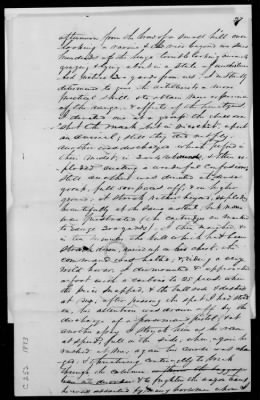
June 28th [1843]
... the command was halted, and riding a very wild horse, I dismounted and approached on foot with a carbine to 25 paces, when the piece snapped, and the bull rose and dashed at me; after passing the spot I had stood on, his attention was drawn off by the di[s]charge of a horseman's pistol; and at another essay I struck him as he ran at speed, full in the side; when, again he rushed at me; again his course was changed; and threatening continually to break through the column, and to frighten the wagon teams he was assailed by many horsemen whom I did not wish to restrain; pistol and carbine shots increased every moment and the frightened horses rendered them dangerous; it seemed a confused action; a doubtful battle: after falling with a great shock, the beast arose and attacked a mounted corporal: tossed his horse like a plaything, goring him in two places: the corporal fell headlong on the bull's horns, his pistol discharged at the same instant, the ball passed through his horse's neck, which then ran off frantically: the man was borne, hanging by his clothes on the horns, for several leaps: a bull dog seized the monster by the lip, and all fell into a confused heap; we next through the dust saw the corporal scrambling desperately from the melee, having wonderfully escaped from injury; the deathless animal again rose, and shook his black and shaggy front, in defiance: then many deliberate carbine shots were fired at him: and he fell and rose repeatedly —while lying down carbine balls were fired with deliberate aim at 10 paces, seemingly without effect: when finally I sent one through the eye into his brain — the shell had broken the shoulder blade. The animal died, and has been eaten; the horse is doing well.
(William E. Connelley, ed., A Journal of the Santa Fe Trail in The Mississippi Valley Historical Review Vol. 12, No. 1 (June 1925), page 97.)Cooke seems to have regretted the breezy treatment of this episode in the magazine and book versions of Scenes and Adventures in the Army. The rewrite condensed the graphic account he had written in his 1843 army journal, incorporating a summary of the affair into one of the ongoing dialogues between the narrating captain and his "Imaginary Friend." Decades later, Cooke managed to get most of the original version into print, when The United States Army and Navy Journal published his letter to the editor under the title, An American "Bull Fight." From The United States Army and Navy Journal, April 8, 1882, page 819:
To the Editor of the Army and Navy Journal:
SIR: I have been delving into the MS. of an old official journal and have found verbal daguerrotypes of some scenes which your readers may find racy, despite their age. Of course they might receive more polished expression, but it would be almost a pity to alter a hue of a picture freshly drawn from nature.
We all have read, ad nauseum, of Spanish bull fights, when the poor beast is cornered and nearly every thing prearranged, but here you find a tolerably fair fight between a valiant buffalo and some two hundred “ horse, foot, and " — artillery. Place, Upper Arkansas; time, June, 1843.
“For six miles we marched through one village of ‘prairie dogs,’ whose shrill barking was incessantly sounding in our cars; but their strange antics scarcely attracted attention when thousands of buffalo, dotting the visible world far and near, were the whole day seen around us; each moment shifting views of chases by officers or traders, fixing the attention with a new interest. In the afternoon from the brow of a small hill we suddenly came in view of hundreds of the huge savage looking animals, grazing and lying about in the most natural manner, only three hundred paces from us. I instantly determined to give the artillerists some desired practice, and to get some experience of the range and effects of the mountain howitzer shells. I directed one myself at a group; the shell passed over it, but in ricochet upset one animal. Another was discharged which passed in their midst in three or four rebounds, and then exploded, creating a wonderful confusion. Still another was directed at a dense group, full five hundred paces off, and on higher ground; it struck rather beyond, exploding beautifully at the same instant, but none were prostrated. I then marched on (rather disgusted in truth with mountain howitzers). In a few minutes, as we approached the bull which had been struck, he raised himself up on his chest; the command was halted. Being mounted on a very wild horse I dismounted and approached him afoot to twenty-five paces, aimed and snapped my carbine. Then the bull rose and rushed at me. After passing the spot I had stood on, his attention was diverted to a horseman and his pistol shot; a moment after, as he was charging past me, I fired and struck him in his side; again he turned and pursued me until his course was changed to a new enemy. The bull seemed set to break through the column; and the baggage train mules, which had come close up, were turning short and trying to run. He was assailed now by many horsemen with a free discharge of pistol shots from riders of prancing horses; it was like a confused and doubtful melee.
“ After falling with a great shock, the bull rose and charged a mounted corporal, tossed his horse like a plaything, goring him in two places; the corporal fell headlong, his pistol at the same instant going off, and the ball passing through his horse‘s neck, which then ran off; but the corporal was caught on a horn, only by his clothes, fortunately, and was thus borne by the bull for several leaps; but a new actor appeared, a bulldog: and he caught the buffalo by his under lip, and then all fell in a confused heap. Next from out the cloud of dust the corporal was seen, desperately scrambling on hands and knees. The deathless animal again rose, and shook at us his shaggy front in defiance. Then many deliberate carbine shots were fired into him, and he fell and rose repeatedly; some were fired close by while he lay, but seemed to have no effect. Finally, I sent a ball through an eye to his brain. The shell had broken a shoulder blade.
“ The poor bull died, and has been eaten—in defiance of nightmare!”
P. St. G. Cooke, U. S. A.
https://books.google.com/books?id=Xvg-AQAAMAAJ&pg=PA819&dq#v=onepage&q&f=falseIn a footnote to his 1925 edition of Cooke's Santa Fe journal, William E. Connelley remarks:
"This is the first instance known to this editor where the buffalo was hunted with artillery and killed with explosive shells fired from cannon."Another editor, Joseph Macaulay Lowe was more sympathetic to the defiant buffalo:
"(If the writer of this book had have been in command, we would have erected a monument to this gallant foe. — Ed.)" -- The National Old Trails Road (Kansas City, 1925) page 110.Lowe called this episode, "The Strangest Battle in History." Cooke again referenced his firsthand narrative of the defiant buffalo bull in A Day's Work of a Captain of Dragoons, published in The United States Army and Navy Journal on July 1, 1882, pages 1106-1107.
https://books.google.com/books?id=Xvg-AQAAMAAJ&pg=PA1106&lpg#v=onepage&q&f=falseRelated post:
“Are all our dreams, then, vain?” sighed Yoomy. “Is this no dawn of day that streaks the crimson East! Naught but the false and flickering lights which sometimes mock Aurora in the north! ..." -- Mardi; and a Voyage Thither
Friend. — A false and self-consuming fire! that sometimes burns to ashes the hearts and hopes of proud men, and leaves but wrecks, mournfully floating upon the dull currents of life. Scenes and Adventures in the Army, pages 333-4
https://archive.org/details/scenesadventures00cook/page/332Revised from the July 1852 installment of Scenes Beyond the Western Border. Revisions include deletion of the interjection "Ay!" spoken by the narrating captain's Imaginary Friend:
I. F. Ay! it is a fire that consumes; and sometimes burns to ashes the hearts and hopes of proud men.... -- Scenes Beyond the Western Border, July 1852.Both versions recall the fire-and-ashes imagery used by Ahab in Moby-Dick, chapter 119:
"Thou canst consume; but I can then be ashes."
"Ah! how very doleful is that plaint! Never, never the doleful!"
--from Scenes Beyond the Western Border (August 1852); and (slightly revised) in Scenes and Adventures in the Army.
The revised 1857 version switches prepositions in and with: calm "with which" revised to calm "in which"; "in fairy creations" then becomes "with fairy creations."
Scenes Beyond the Western Border
Southern Literary Messenger 18 (August 1852): 506
It is near midnight. Silence reigns in the desert; but now and then come the cries of wolves from the mountains. They give an almost supernatural tone to these solemn solitudes. The repose which twenty hours of excitement and toil demand, is banished. Hark! how they howl! Be grandly dreary, and ye will be attuned to the heart! Yes, never better to a sentimental girl the gentlest breathings of an AEolian harp. Ah! how very doleful is that plaint! Never, never, the doleful! Give me the placid calm in which the soul may revel with fairy creations, adorned by all the flowers of thought—or proud action, the storm of wild and passionate will. The gilded and painted memory, or fierce oblivion.
“Great God! but for one single instant show thyself,” cried Starbuck; “never, never wilt thou capture him, old man— --Chapter 134, The Chase—Second Day.PIERRE (1852)
Then, swear to me, dear Pierre, that thou wilt never keep a secret from me—no, never, never;—swear!" 1852 first edition, page 49
Nay, nay, groaned Pierre, never, never, could such syllables be one instant tolerated by her. --page 120
And Pierre felt that never, never would he be able to embrace Isabel with the mere brotherly embrace; --page 193In the same passage from Scenes Beyond the Western Border (August 1852) with "Never, never", the figurative AEolian harp communicates a "plaint" described as "doleful"; in Pierre; Or, The Ambiguities (first published at the end of July 1852), Isabel's guitar voices her "melancholy plaints":
But the wonderful melodiousness of her grief had touched the secret monochord within his breast, by an apparent magic, precisely similar to that which had moved the stringed tongue of her guitar to respond to the heart-strings of her own melancholy plaints. --Page 234THE PIAZZA (1856)
"Oh, sir," tears starting in her eyes, "the first time I looked out of this window, I said 'never, never shall I weary of this.'" --first story in Melville's The Piazza Tales
Oh! my friends, but this is man-killing! --Chapter 98, Stowing Down and Clearing Up.SCENES BEYOND THE WESTERN BORDER (AUGUST 1852)
"O! my friend!"
--Scenes Beyond the Western Border, August 1852Deleted in revision, "O! my friend!" does not appear in the 1857 book version, Scenes and Adventures in the Army.
| "Scenes Beyond the Western Border" Southern Literary Messenger - August 1852 |
Himself was too much for himself. --Herman Melville, Pierre; or, The Ambiguities (1852).
... the imprisoned hero himself sank overwhelmed.... -- Scenes Beyond the Western Border (March 1853); and Scenes and Adventures in the Army (1857).In the examples below, all from Moby-Dick (1851) and Pierre (1852), the reflexive pronoun himself functions also as an intensive pronoun that emphasizes its antecedent (the noun, pronoun, or proper noun that comes before it). Page numbers refer to First American editions, digitized and available online courtesy of HathiTrust Digital Library:
Moby-Dick; or, The Whaleand the Internet Archive:
https://hdl.handle.net/2027/dul1.ark:/13960/t3kw6ns1s
Pierre; or, The Ambiguities
https://hdl.handle.net/2027/hvd.32044011420494
Moby-Dick; or, The Whale
https://archive.org/details/mobydickorwhale01melv/page/n7
Pierre; or, The AmbiguitiesMOBY-DICK [39/205]
https://archive.org/details/pierreorambigui00melvgoog
In crossing the Platte this morning, the grizzly bear cub came on the scene in his final act.
It will be remembered by the patient and attentive future reader of this dry and methodical narrative, that its first appearance on any stage, was in "high" tragedy—that the first act embraced an unusual amount of sanguinary incident—that an innocent brother, (or sister,) being ruthlessly slain, and the baffled lady-mother left (unceremoniously) full of towering and demonstrative rage,— the imprisoned hero himself sank overwhelmed,—or in a well-acted counterfeit of death, (and was borne off, remember, on a "real" horse). That in the next act, (and three acts shall do for the tragedy of my bear,—originally they had but one,—but that was at the sacrifice of a goat,) he came to life in a manner that might very well have been criticized as an overdone piece of stage-effect,—but that in fact, the spectators were much moved, and gave full credit to the dangerous passion of his howl.
To-day, then,—for I scorn anachronism— was performed the final act. The stage (wagon) was on "real water." Enraged at his wrongs, his losses, and his galling chain, the "robustious beast" acted in a ridiculous and unbearable manner; aye, ''tore his passion to tatters, to very rags,"—splinters; the stage (wagon) could not hold him: and finally in despair, he "imitated humanity so abominably," as to throw himself headlong, and so drown—or hang himself: (the author cannot decide which—even after a post mortem examination;—and so leaves the decision of this important point to the commentators).Related posts:
My tragedy is all true,—and if not quite serious, has, as is proper, its moral;—but rather, as I have alluded to the primitive tragedy, let that "future reader" here imagine the entry of Chorus, and their song to Freedom! That dumb beasts prefer death to slavery! Liberty lost, they can die without the excitement of the world's applause, or hopes of a grateful posterity! (It is not possible, I think, that the cub could have known that I would immortalize him.) --March 1853 Scenes Beyond the Western Border"; and Scenes and Adventures in the Army.
So be it, then. Born in throes, 'tis fit that man should live in pains and die in pangs. So be it, then! Here's stout stuff for woe to work on. So be it, then. --Moby-Dick chapter 99 The DoubloonSCENES BEYOND THE WESTERN BORDER (August 1852)
Then so be it! let us treat the whole world as it has done us, and—forget it!
| "Scenes Beyond the Western Border" Southern Literary Messenger - August 1852 |
--August 1852 Scenes Beyond the Western Border; and Scenes and Adventures in the ArmyAmong other things deleted in revision of this August 1852 prairie dialogue, passing the love of women and "nay, I am sure."
With what strange complacency ....
--August 1853 installment of Scenes Beyond The Western Border; and Scenes and Adventures in the Army.MOBY-DICK (1851)
with what wondrous habitude of unconscious skill the whaleman will maintain an erect posture in his boat --The First Lowering
with what prodigious fury the Bashaw assails him, and chases him away! --Schools and Schoolmasters
See with what entire freedom the whaleman takes his handful of lamps --The Lamp
thereby intimating with what deep reverence his portrait would be handled
For he considered with what infinite readiness now, the most faithful portrait of any one could be taken by the Daguerreotype....
With what marvelous precision and exactitude he now went over in his mind all the minutest details of his old joyous life with his mother at Saddle Meadows.In the August 1853 episode, the final installment of Scenes Beyond the Western Border, the narrator's imaginary traveling companion "Frank" quotes well known lines from James Thomson's The Seasons - Summer, slightly altered ("their minds" replacing Thomson's "her mind" or "his mind" in some anthologies).
— ' the smallest part
Exceeds the narrow visions of their minds.' "
 |
| Table of Contents - Scenes and Adventures in the Army |
CHAPTER XVIII.
Romantic Cheyenne Village — Adventures There — Our Few Wants Unsupplied in the Wilderness — March Without Water.... --Contents, part 2 chapter 18 of Scenes and Adventures in the Army (Philadelphia: Lindsay & Blakiston, 1857).
The shores of the Straits of Sunda are unsupplied with those domineering fortresses which guard the entrances to the Mediterranean, the Baltic, and the Propontis.--Chapter 87, The Grand Armada
But here a curious difficulty presented itself. In the excitement of the moment, Ahab had forgotten that since the loss of his leg he had never once stepped on board of any vessel at sea but his own, and then it was always by an ingenious and very handy mechanical contrivance peculiar to the Pequod, and a thing not to be rigged and shipped in any other vessel at a moment's warning. Now, it is no very easy matter for anybody—except those who are almost hourly used to it, like whalemen—to clamber up a ship's side from a boat on the open sea; for the great swells now lift the boat high up towards the bulwarks, and then instantaneously drop it half way down to the kelson. So, deprived of one leg, and the strange ship of course being altogether unsupplied with the kindly invention, Ahab now found himself abjectly reduced to a clumsy landsman again; hopelessly eyeing the uncertain changeful height he could hardly hope to attain. --Chapter 100, Leg and Arm
What would become of a Greenland whale, say, in those shuddering, icy seas of the North, if unsupplied with his cosy surtout? --Chapter 68, The Blanket
Suddenly, with a crash, as of a mountain of rock torn asunder.... --May 1853 Scenes Beyond the Western BorderRevisions to the May 1853 installment of "Scenes Beyond the Western Border" in the Southern Literary Messenger include deletion of the simile introduced with the expression, "as of a...." Cutting "as of a" transforms the metaphorical "mountain of rock" into literal "rocks," vividly re-figured after revision as "Titanic."
But suddenly, with a direful crash amid the Titanic rocks.... --Scenes and Adventures in the ArmyAlso added in revision, along with "Titanic": the adjective "direful" that describes the "crash" which has been made a more immediate and literal, less metaphorical sound, by deleting "as of a." Deleted or added, the verbal elements of this fascinating revision site are all exampled in Herman Melville's writing. The words direful and Titanic feature with particular significance in Moby-Dick (1851) and Pierre (1852), respectively.
And now, loud above the roar of the sea, was suddenly heard a sharp, splintering sound, as of a Norway woodman felling a pine in the forest. --Mardi: And A Voyage Thither
Touched by the breath of the bereaved Aurora, every sunrise that statue gave forth a mournful broken sound, as of a harp-string suddenly sundered, being too harshly wound. --Pierre; or, The AmbiguitiesDIREFUL
white curds of the whale's direful wrath --Moby Dick
Borean and dismasting blasts as direful as any that lash the salted wave; --The Town-Ho's Story
That direful mishap was at the bottom of his temporary recluseness.--Ahab's Legand once in Pierre; or, The Ambiguities:
not entirely untempered to human nature are the most direful blasts of Fate.TITANIC
a fearful pile of Titanic bricks
this Inferno of his Titanic vision.
the mountain once called Delectable, but now styled Titanic.
But now at last since the very blood in his body had in vain rebelled against his Titanic soul;
Such was the wild scenery—the Mount of Titans,Related post:
"There is something in the idea of grandeur with which these high plains inspire me, that I cannot fully understand." --Scenes Beyond the Western Border - August 1852; deleted in revision, not in the book version of this passage as published in Scenes and Adventures in the Army (Philadelphia: Lindsay & Blakiston, 1857), page 361.
"... yet for all these accumulated associations, with whatever is sweet, and honorable, and sublime, there yet lurks an elusive something in the innermost idea of this hue, which strikes more of panic to the soul than that redness which affrights in blood." --Moby-Dick chapter 42, The Whiteness of the Whale.
"WHALES—a word, which, in the popular sense, always conveys an idea of hugeness." --Moby-Dick chapter 32, CetologyIn revision of the August 1852 installment of Scenes Beyond the Western Border, "I cannot fully understand" at the end of a sentence:
"There is something in the idea of grandeur with which these high plains inspire me, that I cannot fully understand."
| Scenes Beyond the Western Border - August 1852 |
"I cannot tell why,—but even with the snow-peaks in view, it seemed the summit of the earth."
 |
| Scenes and Adventures in the Army - page 361 |
"Though I cannot tell why it was exactly that those stage managers, the Fates, put me down for this shabby part of a whaling voyage, when others were set down for magnificent parts in high tragedies, and short and easy parts in genteel comedies, and jolly parts in farces—though I cannot tell why this was exactly...."Compare too (while we're at it) this part, deleted in revision:
--Moby-Dick, Loomings
the idea of grandeur with which these high plains inspire mewith a similar collocation in Moby-Dick of abstract noun (here horror; there grandeur) plus "with which" plus "inspire":
the peculiar horror with which he seemed to inspire the rest of the herdBusted again, right?
F. "Is it not the impression of massiveness, which the extent of the level shape adds to the effect of height?
C. "Something of the sort:—perhaps so...."Something of the sort" in the 1852 version was changed to "There may be something in that."
--August 1852 Scenes Beyond the Western Border
... Traitor, I'll stand by this to the last gasp, you are inebriated, Babbalanja."
"Perhaps so, my lord; but I was treating of the imagination, may it please you."
"It seems to have been added for a postscript," rejoined Braid-Beard, screwing his eyes again.
"Perhaps so," said Babbalanja, "but some wag must have done it."
 |
| http://claretscience3.wikispaces.com/TOUCH |
Like the great dome of St. Peter's, and like the great whale, retain, O man! in all seasons a temperature of thine own. --Moby-Dick, The Blanket (1851)
One of these little infants, that from certain queer tokens seemed hardly a day old, might have measured some fourteen feet in length, and some six feet in girth. He was a little frisky; though as yet his body seemed scarce yet recovered from that irksome position it had so lately occupied in the maternal reticule; where, tail to head, and all ready for the final spring, the unborn whale lies bent like a Tartar’s bow. The delicate side-fins, and the palms of his flukes, still freshly retained the plaited crumpled appearance of a baby’s ears newly arrived from foreign parts. Moby-Dick, The Grand ArmadaIn the example above from the Grand Armada chapter of Moby-Dick, comparison with Melville's source shows definitely that retain is Melville's word--one of his own contributions, added during creative revision of the borrowed passage in Frederick Debell Bennett's A Whaling Voyage Round the Globe (Volume 2, pages 167-8), along with vivid figures also not Bennett's: the "reticule"; "Tartar's bow"; and "baby's ears."
When the substance is gone, men cling to the shadow. Places once set apart to lofty purposes, still retain the name of that loftiness, even when converted to the meanest uses. It would seem, as if forced by imperative Fate to renounce the reality of the romantic and lofty, the people of the present would fain make a compromise by retaining some purely imaginative remainder....--Pierre; Or, The Ambiguities (1852)
"... it was a marvel how, under such circumstances, these hands retained their spotlessness." --The Confidence-Man
For ye who green or gray retainFrom the August 1853 installment of Scenes Beyond The Western Border; and Scenes and Adventures in the Army:
Childhood's illusion, or but feign;
As bride and suite let pass a bier—
So pass the coming canto here. --Clarel Part 2 Canto 35, Prelusive
| Scenes Beyond the Western Border Southern Literary Messenger 19 - August 1853 |
C.—"Well, well,—I wrote what pleased myself; and,—another object I have, which I did not mention: with scarce a book to read, if one did not write, I fancy the beef and pork and beans would in time form a coating round his brain,—turn it all perhaps to thick and solid skull! How is it with you, Frank? Does yours retain a slight softness?"From Mardi: And a Voyage Thither, Volume 2 (Babbalanja Falleth Upon Pimminee Tooth And Nail):
For these Tapparians have no brains. In lieu, they carry in one corner of their craniums, a drop or two of attar of roses; charily used, the supply being small. They are the victims of two incurable maladies: stone in the heart, and ossification of the head.

