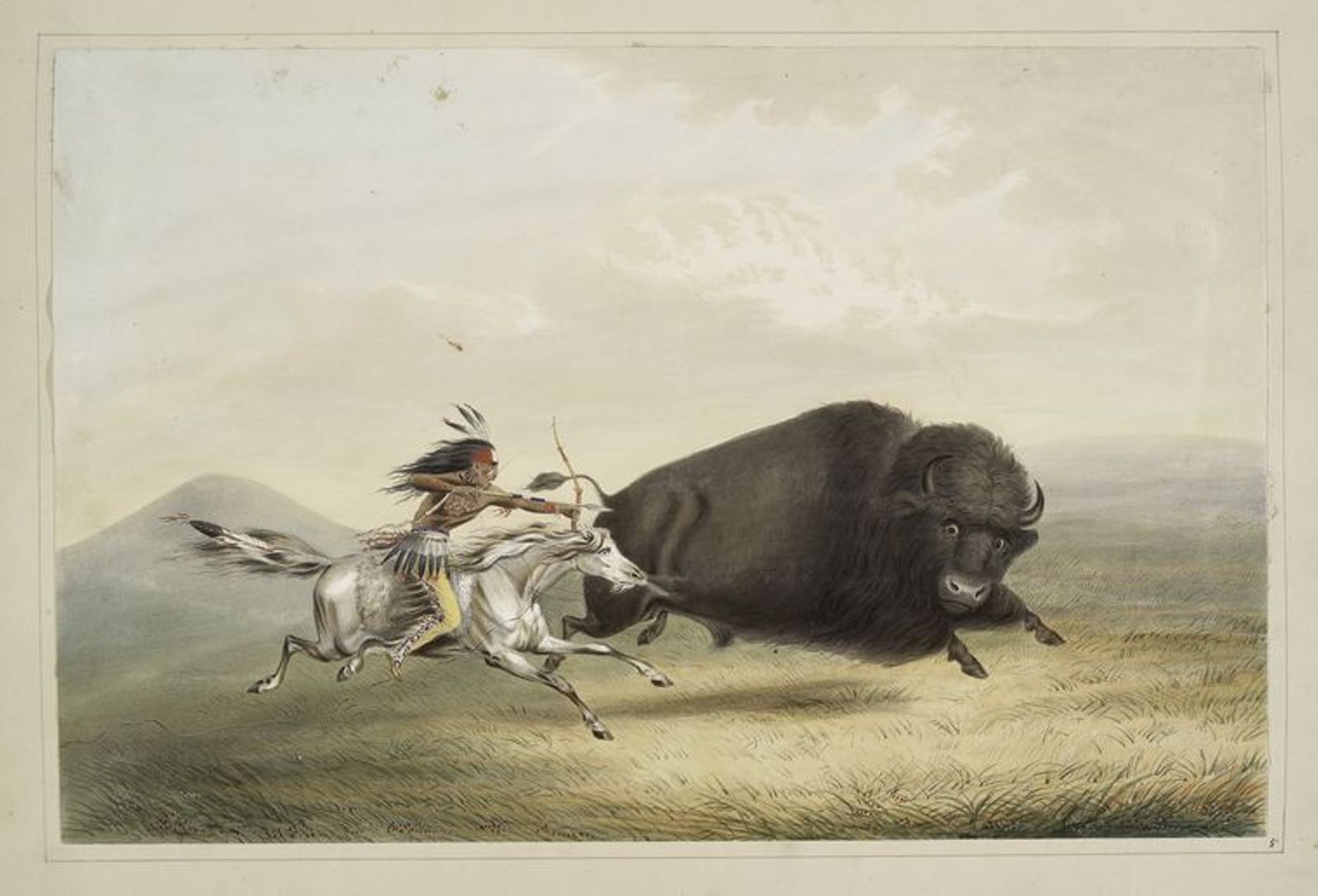
Showing posts with label buffalo. Show all posts

Tuesday, November 26, 2019

Rhetorical questions with whom or what then shall I

MOBY-DICK (October-November 1851)
What then shall I liken the Sperm Whale to for fragrance, considering his magnitude? Must it not be to that famous elephant, with jewelled tusks, and redolent with myrrh, which was led out of an Indian town to do honor to Alexander the Great? -- Moby-Dick; or, The Whale chapter 92, Ambergris.
SCENES BEYOND THE WESTERN BORDER (July 1852)
Whom then shall I address? —the mock sentimentalist? and begin the day: "Our slumbers this morning were gently and pleasantly dissolved by the cheerful martins, which sang a sweet reveille at the first blush of Aurora, at our uncurtained couches." Or the statist? "Not a sign of buffalo to-day; it were melancholy and easy to calculate how soon the Indians, deprived of this natural resource, and ignorant of agriculture"— but I should soon get too deep.
I [maginary]. F [riend]. But this soil is devilish shallow.
--July 1852 Scenes Beyond the Western Border; and Scenes and Adventures in the Army (1857).
Scenes Beyond the Western Border
Southern Literary Messenger (July 1852)
Honorable mention, from Clarel Part 3 Canto 26, Vine and The Palm:
Tropic seraph! thou once gone,
Who then shall take thy office on —
Redeem the waste, and high appear,
Apostle of Talassa’s year
And climes where rivers of waters run?


Sunday, August 4, 2013

pertinacious pursuit

Here be it said, that this pertinacious pursuit of one particular whale, continued through day into night, and through night into day, is a thing by no means unprecedented in the South sea fishery.   
-- Herman Melville, Moby-Dick; Or, The Whale, Chapter 134 The Chase—Second Day. 

This unerring and deadly shot after so long and pertinacious a pursuit, gave him credit with us all.... 
-- "Scenes Beyond the Western Border" in the Southern Literary Messenger Volume 18 for June 1852; and Scenes and Adventures in the Army (Philadelphia: Lindsay & Blakiston, 1857 and 1859) page 310

Wednesday, April 10, 2013

tufted


Bull's Tail, the principal chief (the buffalo, be it remembered,—for this confounded name needs some apology,—carries aloft his tufted tail in combat, like a black flag!) Bull's Tail then, a gentlemanly and mild looking man, made a short and sensible reply.... 
(July 1852 Scenes Beyond the Western Border)
;
and Scenes and Adventures in the Army
A favorite participle or verbal adjective of Melville's, tufted occurs 4x in Moby-Dick:
The opposite wall of this entry was hung all over with a heathenish array of monstrous clubs and spears. Some were thickly set with glittering teeth resembling ivory saws; others were tufted with knots of human hair; and one was sickle-shaped, with a vast handle sweeping round like the segment made in the new-mown grass by a long-armed mower. You shuddered as you gazed, and wondered what monstrous cannibal and savage could ever have gone a death-harvesting with such a hacking, horrifying implement. 
Planted with their broad ends on the deck, a circle of these slabs laced together, mutually sloped towards each other, and at the apex united in a tufted point, where the loose hairy fibres waved to and fro like the top-knot on some old Pottowottamie Sachem's head.  (Moby-Dick)
Chief among these latter was a great Sperm Whale, which, after an unusually long raging gale, had been found dead and stranded, with his head against a cocoa-nut tree, whose plumage-like, tufted droopings seemed his verdant jet. 
 The mast-heads, like the tops of tall palms, were outspreadingly tufted with arms and legs.
Moby-Dick (1851)

 also 3x in Mardi (1849); 2x in Typee (1846); and 1x in Omoo (1847):
Whereupon, the fierce little bull with the tufted forehead flirted his long tail over his buttocks, kicked out with his hind feet, and shot forward a full length.

THE TUFT OF KELP

All dripping in tangles green,
Cast up by a lonely sea
If purer for that, O Weed,
Bitterer, too, are ye?

Saturday, November 17, 2012

Deleted in Revision: "those famous guides to travellers and engineers"

Buffalo, Thermopolis, WY
Photo Credit: Penny Clayton

Compare this, from the March 1853 installment of "Scenes Beyond the Western Border":
"After remounting, yesterday, we threaded the labyrinth before us by aid of the river and old paths of the buffaloes,—those famous guides to travellers and engineers.— One would say there had been war there, among what our fathers called the elements."
(March 1853)
With the same passage as revised for the 1857 book, Scenes and Adventures in the Army:
"July 8th.—After remounting yesterday, we threaded the labyrinth before us by aid of the river, and old paths of the buffalo. One would say there had been war there, among what our fathers called the elements."  (388)
What's wrong with emphasizing in broader terms the usefulness of buffalo paths?  Why bother to edit out the seemingly harmless reference to "travellers and engineers"?

Particularly suggestive is the reference to engineers.  The narrative at this point closely follows that of engineer William B. Franklin in his journal of the 1845 Kearny expedition, March to South Pass:
"By keeping along a buffalo path we have a very  little difficulty in getting down....Keeping along the bank for about a mile, we crossed the river just above the Hot Spring gate, again using a buffalo path to guide us. Just as we arrived at the top of the hill two buffalos rushed past us, descending on the other side with a sure footedness and swiftness wonderful for such unwieldy animals.  They looked fiercer and more dangerous than those we met on the plains, and some remarked that they were the demons of the Mts:  certainly they looked the character." 
(March to South Pass, ed. Frank N. Schubert, Engineer Historical Studies No. 1, p21)
The reference to engineers was deleted perhaps because if retained it might draw uncomfortable attention to the expropriation of material from the journal of a topographical engineer.  William B. Franklin's sighting of two buffaloes had been rewritten once before already, in the previous installment of  "Scenes Beyond the Western Border" (September 1852):
"Unwillingly we turn away, to seek a circuitous outlet, guided by buffalo paths over a lower mountain of confused and many-shaped peaks. At the highest part two monstrous buffaloes suddenly met us in the way:  the gaunt keepers of the pass paused in astonishment, and seemed to stare the question, "What did we there?" or, "Where are we safe?" thought they — if buffaloes think."  (September 1852) 
Amazing! how the rewrite imagines the perspective of the buffaloes, whereas Franklin more conventionally and straightforwardly reports the viewpoint of the human observers.

Saturday, May 26, 2012

misanthropic quadrupeds

"It was the fate of a melancholy buffalo,— whether misused and misanthropic,—shunning the vulgar herd, or exiled, as an old and hardened sinner, to this solitude, to encounter us here...."
(Scenes Beyond the Western Border; and Scenes and Adventures in the Army)

"As for the goats, occasionally you come across a black, misanthropic ram, nibbling the scant herbage of some height inaccessible to man, in preference to the sweet grasses of the valley below."  (Omoo)