Did you hear of the _______? by Scott Norsworthy
A shared 5-gram in "Scenes Beyond the Western Border" and Herman Melville's "The Lightning-Rod Man"
Read on Substack
"Indeed, the settlement of this question must be left to the commentators on Mardi, some four or five hundred centuries hence."
-- Herman Melville, Mardi: And a Voyage Thither

--March 1853 Scenes Beyond the Western Border; and Scenes and Adventures in the Army.
What "you must take" in both cases is somebody's creative writing: Hawthorne's book of short stories and the narrator's unexpected burst into verse.
Take these raspberries, and then I will give you some moss."—"Moss!" said I—"Yes, and you must take it to the barn with you, and good-bye to 'Dwight.'"
--The Literary World Volume 7 (August 17, 1850) page 125.

How dreary must be a great Commodore ,
Alone in the cabin of a seventy-four.
Be not alarmed ! I make a rhyme but once a year ; the idea came in that shape , and you must take it as it comes .
-- Southern Literary Messenger Volume 17 (June 1851) page 372; and Scenes and Adventures in the Army (Philadelphia, 1857) page 228.

"Hundreds go and come at my word; none are my "equals," so none are my social friends."
-- First installment of Scenes Beyond the Western Border, June 1851; and Scenes and Adventures in the Army (1857).
| Southern Literary Messenger Vol. 17 June 1851 |
Concerning the officers of the whale-craft, this seems as good a place as any to set down a little domestic peculiarity on ship-board, arising from the existence of the harpooneer class of officers, a class unknown of course in any other marine than the whale-fleet.
The large importance attached to the harpooneer’s vocation is evinced by the fact, that originally in the old Dutch Fishery, two centuries and more ago, the command of a whale ship was not wholly lodged in the person now called the captain, but was divided between him and an officer called the Specksnyder.... in the American Fishery he is not only an important officer in the boat, but under certain circumstances (night watches on a whaling ground) the command of the ship’s deck is also his; therefore the grand political maxim of the sea demands, that he should nominally live apart from the men before the mast, and be in some way distinguished as their professional superior; though always, by them, familiarly regarded as their social equal.
-- Moby-Dick chapter 33 The Specksynder
 |
| via medievalbooks |
BABBALANJA.—Your Highness, even in his calmer critic moods, Lombardo was far from fancying his work. He confesses, that it ever seemed to him but scrawled copy of something within, which, do what he would, he could not completely transfer. "My canvas was small,” said he; “crowded out were hosts of things that came last. But Fate is in it.” And Fate it was, too, your Highness, which forced Lombardo, ere his work was well done, to take it off his easel, and send it to be multiplied. "Oh, that I was not thus spurred!” cried he; but like many another, in its very childhood, this poor child of mine must go out into Mardi, and get bread for its sire.”
-- Mardi: and a Voyage Thither Vol. 2, Some Pleasant, Shady Talk in the Groves.
In a dialogue on writing from the first installment of Scenes Beyond the Western Border (June 1851), the narrating Captain of U. S. Dragoons marvels at the incredibly rapid production and mass circulation of popular novels by means of the modern steam-powered printing press. To illustrate the staggering increase in productive capacity enabled by modern technology, he imagines (by way of contrast) English workers in the industrial cities of Birmingham and Manchester trying to manufacture or "multiply" Last of the Barons, the 1843 novel by Edward Bulwer Lytton. At best, copying by hand, the most industrious English factory workers might reproduce "one week's supply" of books in manuscript.
Could all the private wealth of England,— could all the hands of Birmingham and Manchester multiply the "Last of the Barons," for instance as in the days of the polished and literary Greeks,—in manuscript—to equal one week's supply! Published in London—and in two months a wanderer in the Rocky Mountains will pass the sultry noon, poring over its pages! Oh! Steam! —
June 1851 Scenes Beyond the Western Border; also in Part II of Scenes and Adventures in the Army (Philadelphia, 1857) page 233.
How Melvillean is the narrator's conceit of factory workers or "hands" (children mostly, in those days) being tasked with publishing literary works by making handwritten copies? Very.
 |
| Detail, 1850 letter from Herman Melville - NYPL Digital Collections |
Can you send me about fifty fast-writing youths, with an easy style and not averse to polishing their labors? If you can, I wish you would, because since I have been here I have planned about that number of future works & cant find enough time to think about them separately. -- Herman Melville, December 1850 letter to Evert Duyckinck.
Manuscripts and Archives Division, The New York Public Library. "1850-1851" The New York Public Library Digital Collections. 1850 - 1851. https://digitalcollections.nypl.org/items/af5f4110-1793-0133-6506-58d385a7bbd
Transcribed in The Letters of Herman Melville, ed. Merrell R. Davis and William H. Gilman (Yale University Press, 1960). https://archive.org/details/in.ernet.dli.2015.84865/page/n155/mode/2up
Katie McGettigan calls this 1850 conceit "Melville's imagined fiction factory." Introducing her 2017 book on Melville's "aesthetic engagement with the material text," McGettigan points out that "Melville figures himself as a manufacturer" and thus conveys "a sense of dash and daring, a desire for the speed and scope that textual production on an industrial scale would offer, and a reveling in the superfluity of production." Herman Melville: Modernity and the Material Text (University of New Hampshire Press, 2017) page 17.
Just six months after the "imagined fiction factory" in Melville's correspondence, Scenes Beyond the Western Border premiered in the June 1851 issue of the Southern Literary Messenger with more such "reveling in the superfluity of production":
... Published in London—and in two months a wanderer in the Rocky Mountains will pass the sultry noon, poring over its pages! Oh! Steam!
Among other significant changes the word buoyant was added in revision of the August 1852 dialogue in Scenes Beyond the Western Border between the narrating Captain of U. S. Dragoons and "Frank," his imaginary friend. As revised in Part II of Scenes and Adventures in the Army (1857), the narrator feels "buoyant and bitter," elevated in spirit by the "wild mountain air" near Devil's Gate and the South Pass of the Rockies.
"I am only in a mood; buoyant and bitter; tameless as the Arab coursing his native desert; free as yonder soaring eagle! it's this wild mountain air!"
| Scenes and Adventures in the Army (1857) page 355 |
| Southern Literary Messenger August 1852 |
F. “When I have you committed, fairly pinned in contradiction, you fly off into a maze of extravagant fancies, where I should be lost as well, if I followed.”
C. “And get the best of it! Ah! my good friend, let this wild mountain air have fair play; let us with the desert's freedom joyously flout convention and opinion—upstart usurpers!—let us make mocking sport of the prosaic solemnity of ignorant prejudice;—let us shoot popguns at least, against the solid bulwarks where folly and selfishness sit enthroned!"
F. “Then fire away!—though hang me if I know what you mean.”
Scenes Beyond the Western Border - August 1852
https://books.google.com/books?id=-AkNAQAAIAAJ&pg=PA508&dq#v=onepage&q&f=false
"Possibly, the vexation might have been something different, were it not for the buoyant confidence inspired by the breeze."
https://books.google.com/books?id=i_FIAAAAcAAJ&pg=PA472&dq#v=onepage&q&f=false
But the book version in The Piazza Tales (1856) replaces buoyant with brisk, thus:
"Possibly, the vexation might have been something different, were it not for the brisk confidence inspired by the breeze."
https://archive.org/details/piazztales00melvrich/page/222/mode/2up
But as for Queequeg—why, Queequeg sat there among them—at the head of the table, too, it so chanced; as cool as an icicle. To be sure I cannot say much for his breeding. His greatest admirer could not have cordially justified his bringing his harpoon in to breakfast with him, and using it there without ceremony; reaching over the table with it. to the imminent jeopardy of many heads, and grappling the beefsteaks towards him. But that was certainly very coolly done by him, and every one knows that in most people's estimation, to do anything coolly is to do it genteelly. -- Chapter 5 - Breakfast
https://archive.org/details/mobydickorwhale01melv/page/34/mode/2upSCENES BEYOND THE WESTERN BORDER (January 1852):
"...But this is coolly and deliberately done."
I. F. — "And what is it?"
—“I say Americanism advisedly; for republicanism is a very different thing, and does not imply rejection of refinement in the higher classes of society."
 |
| Winter pine tree draped in snow. William S. Keller, 1979. via National Park Service |
“Gods and demi-gods! With one gesture all abysses we may disclose; and before this Mardi's eyes, evoke the shrouded time to come. Were this well? Like lost children groping in the woods, they falter through their tangled paths; and at a thousand angles, baffled, start upon each other. And even when they make an onward move, ’tis but an endless vestibule, that leads to naught. -- Herman Melville, Mardi: And a Voyage Thither Volume 2, King Media Dreams.
Like lost children groping in the woods, they falter through their tangled paths; and at a thousand angles, baffled, start upon each other.SCENES BEYOND THE WESTERN BORDER
Did I dream? — Had I slumbered at my post ? — I did dream.In the book version, "the soul profoundly disturbed" has been revised to read, "some divine despair."
And why not tell my dream? — Life is little better; nay, it is little different. We wander at most in the dark—stumbling on temptations,—walking on the thorns of passions; or in an awful, but obscure light, refracted by the cloudy medium of philosophy. Sleep on, my friend! Though I would question you if I could, in this dark hour, if sympathy may pass the mysterious boundary of dream-land;—if that deathlike seeming calm were of careless oblivion,—or of the soul profoundly disturbed. --March 1853 Scenes Beyond the Western Border ; and Scenes and Adventures in the Army.
What then shall I liken the Sperm Whale to for fragrance, considering his magnitude? Must it not be to that famous elephant, with jewelled tusks, and redolent with myrrh, which was led out of an Indian town to do honor to Alexander the Great? -- Moby-Dick; or, The Whale chapter 92, Ambergris.SCENES BEYOND THE WESTERN BORDER (July 1852)
Whom then shall I address? —the mock sentimentalist? and begin the day: "Our slumbers this morning were gently and pleasantly dissolved by the cheerful martins, which sang a sweet reveille at the first blush of Aurora, at our uncurtained couches." Or the statist? "Not a sign of buffalo to-day; it were melancholy and easy to calculate how soon the Indians, deprived of this natural resource, and ignorant of agriculture"— but I should soon get too deep.
I [maginary]. F [riend]. But this soil is devilish shallow.
--July 1852 Scenes Beyond the Western Border; and Scenes and Adventures in the Army (1857).
| Scenes Beyond the Western Border Southern Literary Messenger (July 1852) |
Tropic seraph! thou once gone,
Who then shall take thy office on —
Redeem the waste, and high appear,
Apostle of Talassa’s year
And climes where rivers of waters run?
 |
| Buffalo Bull, Grazing on the Prairie. George Catlin. Smithsonian American Art Museum |
... wonderful it was to think that a bull, after being wounded and stunned by a twelve-pound shell, should rush upon a great column of horse, and heedless of a hundred shots and twenty wounds, with a bull-dog to his lip, should toss a horse and rider like a feather.... -- Scenes Beyond the Western Border, September 1851; and Scenes and Adventures in the Army, pages 260-261.
| Southern Literary Messenger - September 1851 |
... the White Whale churning himself into furious speed, almost in an instant as it were, rushing among the boats with open jaws, and a lashing tail, offered appalling battle on every side; and heedless of the irons darted at him from every boat, seemed only intent on annihilating each separate plank of which those boats were made. -- Moby-Dick chapter 134, The Chase—Second Day.The word heedless does not appear in the source-text for the affair of the death-defying buffalo, the entry for June 28th in Philip St. George Cooke's 1843 Journal of the Santa Fe Trail. Transcribed by William E. Connelley in The Mississippi Valley Historical Review Vol. 12, No. 1 (June 1925), pages 72-98; and Vol. 12, No. 2 (September 1925), pages 227-255. For Cooke's 1843 journal in manuscript, see National Archives Letters Received by the Office of the Adjutant General 1822-1860 / 1843 / C / Cooke, P St G / C252; available online via fold3.
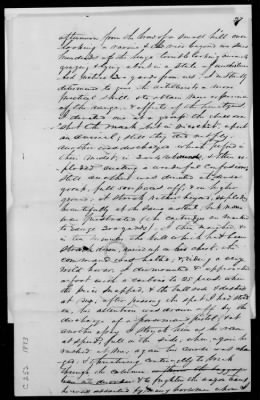
June 28th [1843]
... the command was halted, and riding a very wild horse, I dismounted and approached on foot with a carbine to 25 paces, when the piece snapped, and the bull rose and dashed at me; after passing the spot I had stood on, his attention was drawn off by the di[s]charge of a horseman's pistol; and at another essay I struck him as he ran at speed, full in the side; when, again he rushed at me; again his course was changed; and threatening continually to break through the column, and to frighten the wagon teams he was assailed by many horsemen whom I did not wish to restrain; pistol and carbine shots increased every moment and the frightened horses rendered them dangerous; it seemed a confused action; a doubtful battle: after falling with a great shock, the beast arose and attacked a mounted corporal: tossed his horse like a plaything, goring him in two places: the corporal fell headlong on the bull's horns, his pistol discharged at the same instant, the ball passed through his horse's neck, which then ran off frantically: the man was borne, hanging by his clothes on the horns, for several leaps: a bull dog seized the monster by the lip, and all fell into a confused heap; we next through the dust saw the corporal scrambling desperately from the melee, having wonderfully escaped from injury; the deathless animal again rose, and shook his black and shaggy front, in defiance: then many deliberate carbine shots were fired at him: and he fell and rose repeatedly —while lying down carbine balls were fired with deliberate aim at 10 paces, seemingly without effect: when finally I sent one through the eye into his brain — the shell had broken the shoulder blade. The animal died, and has been eaten; the horse is doing well.
(William E. Connelley, ed., A Journal of the Santa Fe Trail in The Mississippi Valley Historical Review Vol. 12, No. 1 (June 1925), page 97.)Cooke seems to have regretted the breezy treatment of this episode in the magazine and book versions of Scenes and Adventures in the Army. The rewrite condensed the graphic account he had written in his 1843 army journal, incorporating a summary of the affair into one of the ongoing dialogues between the narrating captain and his "Imaginary Friend." Decades later, Cooke managed to get most of the original version into print, when The United States Army and Navy Journal published his letter to the editor under the title, An American "Bull Fight." From The United States Army and Navy Journal, April 8, 1882, page 819:
To the Editor of the Army and Navy Journal:
SIR: I have been delving into the MS. of an old official journal and have found verbal daguerrotypes of some scenes which your readers may find racy, despite their age. Of course they might receive more polished expression, but it would be almost a pity to alter a hue of a picture freshly drawn from nature.
We all have read, ad nauseum, of Spanish bull fights, when the poor beast is cornered and nearly every thing prearranged, but here you find a tolerably fair fight between a valiant buffalo and some two hundred “ horse, foot, and " — artillery. Place, Upper Arkansas; time, June, 1843.
“For six miles we marched through one village of ‘prairie dogs,’ whose shrill barking was incessantly sounding in our cars; but their strange antics scarcely attracted attention when thousands of buffalo, dotting the visible world far and near, were the whole day seen around us; each moment shifting views of chases by officers or traders, fixing the attention with a new interest. In the afternoon from the brow of a small hill we suddenly came in view of hundreds of the huge savage looking animals, grazing and lying about in the most natural manner, only three hundred paces from us. I instantly determined to give the artillerists some desired practice, and to get some experience of the range and effects of the mountain howitzer shells. I directed one myself at a group; the shell passed over it, but in ricochet upset one animal. Another was discharged which passed in their midst in three or four rebounds, and then exploded, creating a wonderful confusion. Still another was directed at a dense group, full five hundred paces off, and on higher ground; it struck rather beyond, exploding beautifully at the same instant, but none were prostrated. I then marched on (rather disgusted in truth with mountain howitzers). In a few minutes, as we approached the bull which had been struck, he raised himself up on his chest; the command was halted. Being mounted on a very wild horse I dismounted and approached him afoot to twenty-five paces, aimed and snapped my carbine. Then the bull rose and rushed at me. After passing the spot I had stood on, his attention was diverted to a horseman and his pistol shot; a moment after, as he was charging past me, I fired and struck him in his side; again he turned and pursued me until his course was changed to a new enemy. The bull seemed set to break through the column; and the baggage train mules, which had come close up, were turning short and trying to run. He was assailed now by many horsemen with a free discharge of pistol shots from riders of prancing horses; it was like a confused and doubtful melee.
“ After falling with a great shock, the bull rose and charged a mounted corporal, tossed his horse like a plaything, goring him in two places; the corporal fell headlong, his pistol at the same instant going off, and the ball passing through his horse‘s neck, which then ran off; but the corporal was caught on a horn, only by his clothes, fortunately, and was thus borne by the bull for several leaps; but a new actor appeared, a bulldog: and he caught the buffalo by his under lip, and then all fell in a confused heap. Next from out the cloud of dust the corporal was seen, desperately scrambling on hands and knees. The deathless animal again rose, and shook at us his shaggy front in defiance. Then many deliberate carbine shots were fired into him, and he fell and rose repeatedly; some were fired close by while he lay, but seemed to have no effect. Finally, I sent a ball through an eye to his brain. The shell had broken a shoulder blade.
“ The poor bull died, and has been eaten—in defiance of nightmare!”
P. St. G. Cooke, U. S. A.
https://books.google.com/books?id=Xvg-AQAAMAAJ&pg=PA819&dq#v=onepage&q&f=falseIn a footnote to his 1925 edition of Cooke's Santa Fe journal, William E. Connelley remarks:
"This is the first instance known to this editor where the buffalo was hunted with artillery and killed with explosive shells fired from cannon."Another editor, Joseph Macaulay Lowe was more sympathetic to the defiant buffalo:
"(If the writer of this book had have been in command, we would have erected a monument to this gallant foe. — Ed.)" -- The National Old Trails Road (Kansas City, 1925) page 110.Lowe called this episode, "The Strangest Battle in History." Cooke again referenced his firsthand narrative of the defiant buffalo bull in A Day's Work of a Captain of Dragoons, published in The United States Army and Navy Journal on July 1, 1882, pages 1106-1107.
https://books.google.com/books?id=Xvg-AQAAMAAJ&pg=PA1106&lpg#v=onepage&q&f=falseRelated post:
“Are all our dreams, then, vain?” sighed Yoomy. “Is this no dawn of day that streaks the crimson East! Naught but the false and flickering lights which sometimes mock Aurora in the north! ..." -- Mardi; and a Voyage Thither
Friend. — A false and self-consuming fire! that sometimes burns to ashes the hearts and hopes of proud men, and leaves but wrecks, mournfully floating upon the dull currents of life. Scenes and Adventures in the Army, pages 333-4
https://archive.org/details/scenesadventures00cook/page/332Revised from the July 1852 installment of Scenes Beyond the Western Border. Revisions include deletion of the interjection "Ay!" spoken by the narrating captain's Imaginary Friend:
I. F. Ay! it is a fire that consumes; and sometimes burns to ashes the hearts and hopes of proud men.... -- Scenes Beyond the Western Border, July 1852.Both versions recall the fire-and-ashes imagery used by Ahab in Moby-Dick, chapter 119:
"Thou canst consume; but I can then be ashes."
 |
| Goldsmith's History of the Earth and Animated Nature |
"... to and fro, toss the wide woodlands: all the world an elk, and the forests its antlers."
The noble creatures, with a whole forest of antlers, taking the alarm, first began to trot round loftily, with heads tossed high in air....
 |
| Detail. Front cover, January 1852 Southern Literary Messenger |

"Ah! how very doleful is that plaint! Never, never the doleful!"
--from Scenes Beyond the Western Border (August 1852); and (slightly revised) in Scenes and Adventures in the Army.
The revised 1857 version switches prepositions in and with: calm "with which" revised to calm "in which"; "in fairy creations" then becomes "with fairy creations."
Scenes Beyond the Western Border
Southern Literary Messenger 18 (August 1852): 506
It is near midnight. Silence reigns in the desert; but now and then come the cries of wolves from the mountains. They give an almost supernatural tone to these solemn solitudes. The repose which twenty hours of excitement and toil demand, is banished. Hark! how they howl! Be grandly dreary, and ye will be attuned to the heart! Yes, never better to a sentimental girl the gentlest breathings of an AEolian harp. Ah! how very doleful is that plaint! Never, never, the doleful! Give me the placid calm in which the soul may revel with fairy creations, adorned by all the flowers of thought—or proud action, the storm of wild and passionate will. The gilded and painted memory, or fierce oblivion.
“Great God! but for one single instant show thyself,” cried Starbuck; “never, never wilt thou capture him, old man— --Chapter 134, The Chase—Second Day.PIERRE (1852)
Then, swear to me, dear Pierre, that thou wilt never keep a secret from me—no, never, never;—swear!" 1852 first edition, page 49
Nay, nay, groaned Pierre, never, never, could such syllables be one instant tolerated by her. --page 120
And Pierre felt that never, never would he be able to embrace Isabel with the mere brotherly embrace; --page 193In the same passage from Scenes Beyond the Western Border (August 1852) with "Never, never", the figurative AEolian harp communicates a "plaint" described as "doleful"; in Pierre; Or, The Ambiguities (first published at the end of July 1852), Isabel's guitar voices her "melancholy plaints":
But the wonderful melodiousness of her grief had touched the secret monochord within his breast, by an apparent magic, precisely similar to that which had moved the stringed tongue of her guitar to respond to the heart-strings of her own melancholy plaints. --Page 234THE PIAZZA (1856)
"Oh, sir," tears starting in her eyes, "the first time I looked out of this window, I said 'never, never shall I weary of this.'" --first story in Melville's The Piazza Tales
Oh! my friends, but this is man-killing! --Chapter 98, Stowing Down and Clearing Up.SCENES BEYOND THE WESTERN BORDER (AUGUST 1852)
"O! my friend!"
--Scenes Beyond the Western Border, August 1852Deleted in revision, "O! my friend!" does not appear in the 1857 book version, Scenes and Adventures in the Army.
| "Scenes Beyond the Western Border" Southern Literary Messenger - August 1852 |

