Saturday, January 6, 2018

retain what? temperature, youth, loftiness, spotlessness, softness

http://claretscience3.wikispaces.com/TOUCH
Like the great dome of St. Peter's, and like the great whale, retain, O man! in all seasons a temperature of thine own. --Moby-Dick, The Blanket (1851) 
One of these little infants, that from certain queer tokens seemed hardly a day old, might have measured some fourteen feet in length, and some six feet in girth. He was a little frisky; though as yet his body seemed scarce yet recovered from that irksome position it had so lately occupied in the maternal reticule; where, tail to head, and all ready for the final spring, the unborn whale lies bent like a Tartar’s bow. The delicate side-fins, and the palms of his flukes, still freshly retained the plaited crumpled appearance of a baby’s ears newly arrived from foreign parts. Moby-Dick, The Grand Armada
In the example above from the Grand Armada chapter of Moby-Dick, comparison with Melville's source shows definitely that retain is Melville's word--one of his own contributions, added during creative revision of the borrowed passage in Frederick Debell Bennett's A Whaling Voyage Round the Globe (Volume 2, pages 167-8), along with vivid figures also not Bennett's: the "reticule"; "Tartar's bow"; and "baby's ears."
When the substance is gone, men cling to the shadow. Places once set apart to lofty purposes, still retain the name of that loftiness, even when converted to the meanest uses. It would seem, as if forced by imperative Fate to renounce the reality of the romantic and lofty, the people of the present would fain make a compromise by retaining some purely imaginative remainder....--Pierre; Or, The Ambiguities (1852)
"... it was a marvel how, under such circumstances, these hands retained their spotlessness."  --The Confidence-Man
For ye who green or gray retain
Childhood's illusion, or but feign;
As bride and suite let pass a bier—
So pass the coming canto here.  --Clarel Part 2 Canto 35, Prelusive
From the August 1853 installment of Scenes Beyond The Western Border; and Scenes and Adventures in the Army:


Scenes Beyond the Western Border
Southern Literary Messenger 19 - August 1853
C.—"Well, well,—I wrote what pleased myself; and,—another object I have, which I did not mention: with scarce a book to read, if one did not write, I fancy the beef and pork and beans would in time form a coating round his brain,—turn it all perhaps to thick and solid skull! How is it with you, Frank? Does yours retain a slight softness?"
From Mardi: And a Voyage Thither, Volume 2 (Babbalanja Falleth Upon Pimminee Tooth And Nail):
For these Tapparians have no brains. In lieu, they carry in one corner of their craniums, a drop or two of attar of roses; charily used, the supply being small. They are the victims of two incurable maladies: stone in the heart, and ossification of the head.

Thursday, January 4, 2018

1857 Utah expedition

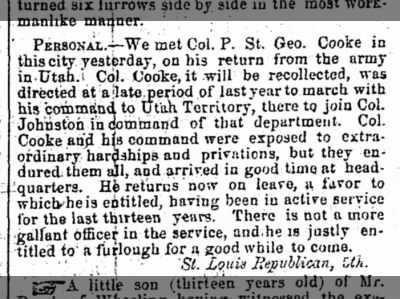
"I have one hundred and forty-four horses, and have lost one hundred and thirty-four. Most of the loss has occurred much this side of South Pass, in comparatively moderate weather. It has been of starvation. The earth has a no more lifeless, treeless, grassless desert; it contains scarcely a wolf to glut itself on the hundreds of dead and frozen animals which for thirty miles nearly block the road with abandoned and shattered property, they mark, perhaps, beyond example in history, the steps of an advancing army with the horrors of a disastrous retreat." --Philip St. George Cooke

The report by Philip St. George Cooke of his 1857 march in brutal winter conditions from Fort Leavenworth, Kansas to Fort Bridger, Wyoming is available in a Congressional publication of 1858 (Thirty-fifth Congress, first session, House of Representatives, Ex. Doc. No. 71) titled The Utah expedition.


Cooke's gritty narrative also circulated widely in contemporary newspapers. The New York Times (January 29, 1858), published the entire account, aptly described in another column as "terse and graphic." On February 4, 1858 the Pittsfield Sun gave extensive quotes from Cooke's report in an article reprinted from the Boston Post under the heading, "Col. Cook's March to Join the Utah Army." Elsewhere headlines read "Terrible Sufferings."
Pittsfield Sun - February 4, 1858

Thursday, December 28, 2017

Well, well

From Pierre; Or, The Ambiguities (1852):
"Well, well, well," cried Pierre rapidly and impetuously; "we both knew that before."
"Well, well, well, Pierre," retorted his mother, mockingly.
"It is not well, well, well; but ill, ill, ill, to torture me so, mother; go on, do!"
Dearest Lucy!—well, well;—'twill be a pretty time we'll have this evening; there's the book of Flemish prints—that first we must look over....
"Well, well; go on, go on, aunt; you can't think how interested I am," said little Pierre,
Well, well, I never thought to cast them back into the sordid circulations whence they came. 
"Well, well, wonders is all the go. I thought I had done with wondering when I passed fifty; but I keep wondering still.... Well, well, well, well, well; of all colics, save me from the melloncholics; green melons is the greenest thing!"
"Oh! is that you, sir? well, well, then;" and the man set down the easel.
"Well, well, Isabel," stammeringly replied Pierre; while a mysterious color suffused itself over his whole face, neck, and brow; and involuntarily he started a little back from her self-proffering form.
The locution Well, well occurs 9x in Moby-Dick, for example:
Well, well, what’s signed, is signed; and what’s to be, will be; and then again, perhaps it won’t be, after all.
From the August 1853 installment of Scenes Beyond The Western Border; and Scenes and Adventures in the Army:

Scenes Beyond the Western Border
Southern Literary Messenger 19 - August 1853
C.—"Well, well,—I wrote what pleased myself; and,—another object I have, which I did not mention: with scarce a book to read, if one did not write, I fancy the beef and pork and beans would in time form a coating round his brain,—turn it all perhaps to thick and solid skull! How is it with you, Frank? Does yours retain a slight softness?"

your everlasting blank

Both instances occur in dialogue about discourse.
“A truce to your everlasting pratings of old Bardianna,” said King Media; “why not speak your own thoughts, Babbalanja: then would your discourse possess more completeness; whereas, its warp and woof are of all sorts, Bardianna, Alla-Malolla, Vavona, and all the writers that ever have written. Speak for yourself, mortal." --Mardi: And a Voyage Thither

"I find you guilty of 'carelessness' certainly; and, by-the-by, you have not a word of our detour over the beautiful plain of Chouteau's Island! Then, indeed, your everlasting 'Memories' seemed strong enough; and what was better, almost tangibly real; I could almost see the five hundred painted and yelling Camanches charging at full speed to surprise your camp. And then an inexperienced youth of twenty years." --August 1853 Scenes Beyond the Western Border; and Scenes and Adventures in the Army

Thursday, December 21, 2017

pleasantly and gently

via The New York Public Library Digital Collections
Canes, laid on palm trunks, formed the floor. How elastic! In vogue all over Odo, among the chiefs, it imparted such a buoyancy to the person, that to this special cause may be imputed in good part the famous fine spirits of the nobles. 
Hypochondriac! essay the elastic flooring! It shall so pleasantly and gently jolt thee, as to shake up, and pack off the stagnant humors mantling thy pool-like soul. Such was my dwelling.... --Mardi - Taji Retires from the World
In the July 1852 installment of "Scenes Beyond the Western Border" the collocation of gently with pleasantly occurs also in the context of a domestic retreat from "the world."


Whom then shall I address? — the mock sentimentalist? and begin the day: "Our slumbers this morning were gently and pleasantly dissolved by the cheerful martins, which sang a sweet reveille with the first blush of Aurora, at our uncurtained couches." 
-- Scenes Beyond the Western Border, July 1852 ; and Scenes and Adventures in the Army, page 332.
Melville's Taji "retires from the world" as announced in heading to chapter 62 in the first volume of Mardi.  The Captain of U. S. Dragoons decides (after self-consciously experimenting with contrastive narrative modes, romantic or "sentimentalist" vs. politician, bureaucrat or "statist") that he would prefer a "friendly" reader in a "poetic mood" over "the shallow or hurried worldling." The sentence expressing this determination also appears without comment as sole epigraph to the 1857 book version:
"I address not then, the shallow or hurried worldling; but the friendly one, who in the calm intervals from worldly cares, grants me the aid of a quiet and thoughtful,—and if it may be,—a poetic mood." --July 1852 - Scenes Beyond the Western Border; epigraph in Scenes and Adventures in the Army.


Also worth a closer look: the narrator's enthusiasm in Mardi for bouncy flooring in the homes of islanders has an interesting parallel in the May 1853 installment of Scenes Beyond the Western Border. The contexts are similarly domestic, the representations intensely romantic. As Taji extolled the virtues of cane floors, in repeated exclamations, so the dragoon-narrator praises the advantages of Cheyenne lodgings:
How enviable is the Chian! Such is his simple, clean, comfortable house; so cheap, so moveable! When his summer carpet—of green velvet—wears out, how easy to move to another; to select some still pleasanter spring or valley, and enjoy the change of scene and air; free of the curses and the cares entailed by civilization. -- May 1853 - Scenes Beyond the Western Border; and Scenes and Adventures in the Army
In Pierre (1852) Melville uses the expression "summer carpet of green" when satirizing romanticized views of poverty:
Go to! God hath deposited cash in the Bank subject to our gentlemanly order; he hath bounteously blessed the world with a summer carpet of green. Begone, Heraclitus! The lamentations of the rain are but to make us our rainbows!  --Pierre; Or, the Ambiguities
And another thing, speaking of similar ways of praising domestic comforts in "Scenes Beyond the Western Border" and known writings by Herman Melville. The use of enviable by the dragoon-narrator to describe "the Chian" in his "clean, comfortable," inexpensive and portable home recalls Melville's use of the same adjective in praise of
" those enviable little tents or pulpits, called crow's-nests, in which the lookouts of a Greenland whaler are protected from the inclement weather of the frozen seas." 
--Moby-Dick, chapter 35 - The Mast-Head
Related post:

Wednesday, December 20, 2017

I have alluded to


Lucy, this note may seem mysterious; but if it shall, I did not mean to make it so; nor do I know that I could have helped it. But the only reason is this, Lucy: the matter which I have alluded to, is of such a nature, that, for the present I stand virtually pledged not to disclose it to any person but those more directly involved in it.
--Herman Melville, Pierre; Or, The Ambiguities (1852) .


My tragedy is all true,--and if not quite serious, has, as is proper, its moral;--but rather, as I have alluded to the primitive tragedy....
--Scenes Beyond the Western Border (March 1853); and Scenes and Adventures in the Army.

Sunday, November 19, 2017

Sketches of the Great West in The Washington Union

Newspapers.com now has The Washington Union (October 6, 1845) with "Sketches of the West" by Philip St. George Cooke. Many passages from Cooke's published "Sketches" were later revised and incorporated in the 1851-1853 magazine series "Scenes Beyond the Western Border," which in turn became Part II of the 1857 book, Scenes and Adventures in the Army.

Found on Newspapers.com

The text is already transcribed on the Dragooned page for Sketches of the Great West.