Monday, August 19, 2013

embellished "indomitable hunter" entry for June 22, 1845, compared to plain accounts by fellow officers


To see how extraordinarily elaborate and literary the indomitable hunter passage really is, we probably should compare it to the straightforward reports for the same day by fellow officers and diarists J. Henry Carleton, William B. Franklin, and Henry S. Turner.

Carleton's is the closest to Cooke's.  Indeed, Carleton's narrative, originally published in the New York Spirit of the Times, looks like it might be the main source for Cook's expanded treatment.  Carleton is the only one (besides Cooke) to mention Captain Moore by name, when describing highlights of the previous day:
On the evening of the 21st, a large grizzly bear started up immediately in front of the command.  Captain Moore succeeded in striking it with a charge of buckshot, and chase was immediately given to it by several of the officers.  After an exciting race, the bear gained a small thicket, and finally escaped--though not without making three or four fierce charges from its cover at the horsemen, and scattering them right and left.  The buffalo range was again struck on the 22d., and the flesh of two fine cows was brought into camp by the hunters, after night-fall.
-- J. Henry Carleton, The Prairie Logbooks: Dragoon Campaigns to the Pawnee villages in 1844, and to the Rocky mountains in 1845, ed. Louis Pelzer (The Caxton Club, Chicago, 1943) page 256.
Yes, that's it!

Lieutenant Franklin also wrote about the memorable confrontation with a grizzly bear on the 21st, but gave no information about the buffalo hunt of the following day:
June 22.  To-day we were to leave the Platte and strike for the Sweetwater.  1 1/2 miles from camp we crossed the river and gradually left it.  In about 12 miles we reached the bitter spring where there was some good grass but very bad water.  It was a very hot day and this water almost as nauseous as sea water was delicious to us.  We stopped here a couple of hours, and then went to a spring 13 miles further, where we encamped.

For the first 12 miles the face of the country was comparatively smooth, that is there were no rocks.  But during the last 13 miles I noted limestone of various degrees of hardness, and now and then a granite boulder.  Some of the limestone has numerous impressions of shells in it.  The distance today was 25 miles, and the direction for the first 12 miles, 10 S of W, for the remainder of the distance nearly SW.

We noticed many salt efflorescences during the day's march, accounting well for the bitterness of the water. --William B. Franklin, March to the South Pass, ed. Frank N. Schubert (Office of the Chief of Engineers: Washington, D. C., 1979) page 17.
Like Carleton, Turner described the confrontation with the grizzly bear by the command.  Carleton and Turner agree that the command encountered the grizzly on the 21st of June.  On the next day, buffalo meat was furnished by the designated hunters (not the command that included Cooke's fellow officer, dragoon captain Benjamin D. Moore):
Camp N. 32. June 22. Crossed the river for the last time on the outward march—depth about 3 feet—width about 300 yards. Marched in a N. westerly direction, leaving high & bald ridges on our left; arrived at the “Bitter Spring” about 11 A.M. this spring takes its name from the peculiar saline taste of its water. Our animals however drunk of it freely. Our guide had promised us good grazing at this point, but on arriving at it we found it grazed to the roots by the Buffalo: a large herd moved off as we approached it; having halted an hour to permit our poor animals to feed as they best could, we continued on 13 miles & halted for the night at a spot which promised good & abundant water, but nothing else. The grass usually good is routinely eaten up by Buffalo. So far as our animals are concerned, & our well being just now is very intimately connected with theirs, we have indeed a gloomy prospect just now. Our grazing must improve, or they will scarcely be able to return to Laramie. We hope for much from the valley of the “Sweet-Water,” which we must reach tomorrow. Many Buffalo seen to day. The command has been subsisted for several days by the hunters. Distance 27 miles. Direction N. of W. Weather cool & clear.  "Journal of an Expedition" at fold3
(Letters Received by the Adjutant General, 1845 Kearny, SW, K113 page 52) Saw lots of buffalo, hunters come back with buffalo meat--and basically (again) that's it!

Three contemporary accounts of the same day's march, each in its way serious and relatively straightforward.  As you can see, none of the three participants described anything like the fierce pursuit by a "wild huntsman" that is so extravagantly fantasized in the August 1852 installment of Scenes Beyond the Western Border:
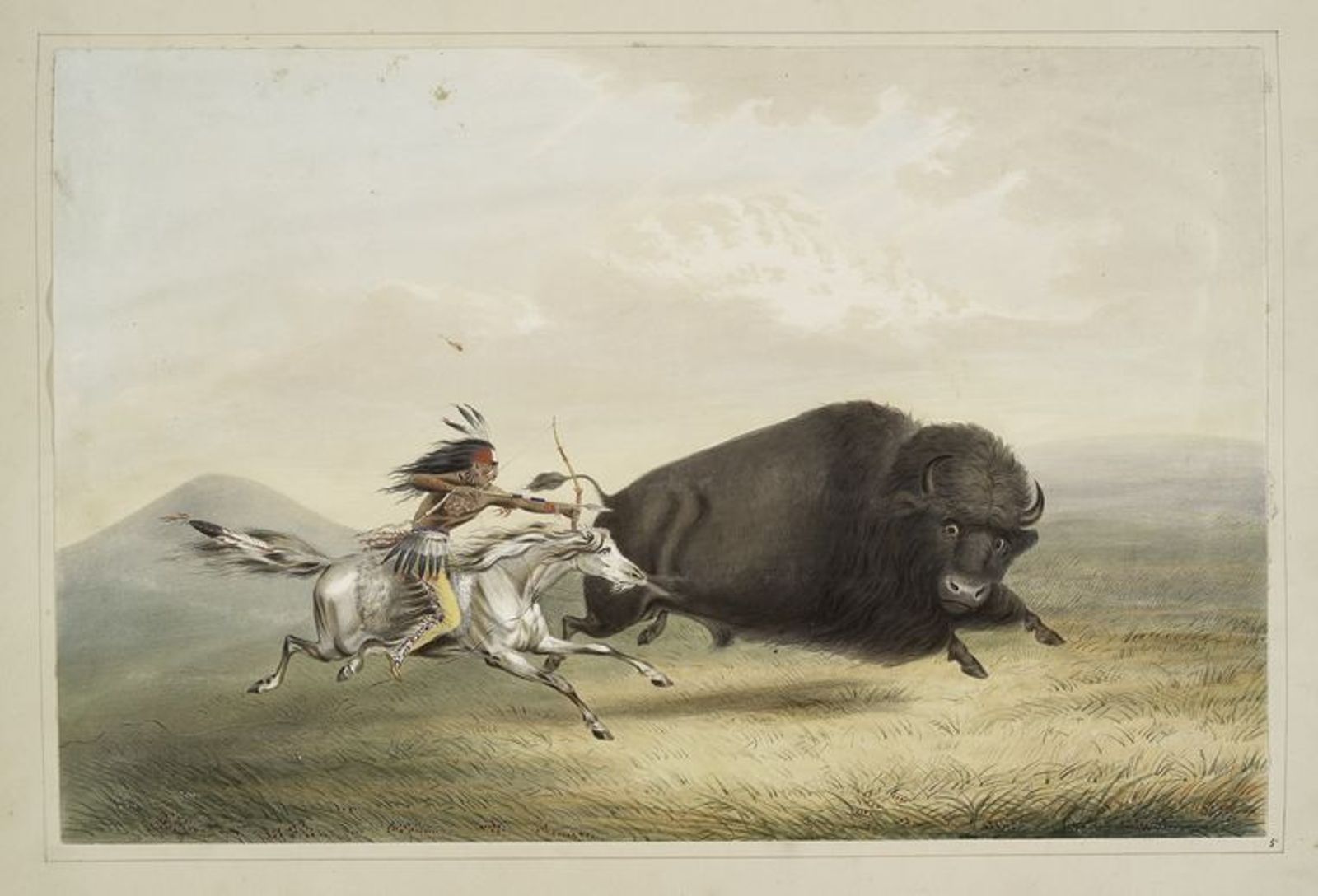
Amid the mirage and white dust, and the dizzy glow of reflected light and heat, which nearly turned the brain, I have still in my mind's eye a kind of vision of the indomitable hunter, Capt. M., scudding over far black slopes, which seemed themselves in wavy motion, fiercely pursuing flying buffaloes: it was a rivalry of all the German extravagance of their favorite legend of the wild huntsman. The facts seem simple, but there was an unnatural strangeness, a suffocating, alarming heat in the dazzling plains, and the black hills, that gave a dreamy confusion and doubt to realities. Did then, the strange mirage cheat the senses with apparitions of a desperate hunter, on that wonderful gray horse, pursuing black monsters, far, far and indistinctly into the glowing haze?

After all, we knew it was Ben. Moore,* or the devil! But it had always been said that he would follow a buffalo to the abode—left to that imagination which here seemed realized. 
Battle of San Pasqual by William H Meyers c1846

the indomitable hunter, chasing monsters

Odin's hunt (Malmström)

In the March 1853 and August 1853 installments of Scenes Beyond the Western Border, we found Philip St George Cooke (more likely, his ghostwriter) preoccupied with language and arguments that had been forcefully employed by critics of Melville's latest book, Pierre (1852).

The year before, the August 1852 featured a similar kind of episode, wherein the writer has oddly and imaginatively expanded the narrative using language employed by critics of Melville's previous book.

Yep, that would be Moby-Dick (1851).
June 22d.—Independence Rock.—Yesterday, we forded and left the Platte, to turn confused masses of mountains with picturesque red-rock precipices, which there begin to wall it in; it is called the Red But[t]es. We passed one spring, with a little grass, about half way of our march of twenty seven miles to another. The last half was the most desolate and wild region we had seen: high plains where there was nothing but clay or sand, and a few stunted, dusty artemisias, interspersed with great rock-hills of dark volcanic appearance. We had to dispute possession with buffalo of the small well-cropped oasis where we encamped, and with another grizzly bear, which we routed out, at dusk, after it had greatly alarmed the horses.

About 5 o'clock, this morning we were in the saddle, anxious—with the famed Sweet Water for our goal—to finish the remaining twenty-five miles of desert. We passed several springs, with a little grass, bog, and some plum bushes; as we neared the river, the country grew more wildly barren; there was a great plain of white sand, and, here and there, of glittering Epsom Salts! Amid the mirage and white dust, and the dizzy glow of reflected light and heat, which nearly turned the brain, I have still in my mind's eye a kind of vision of the indomitable hunter, Capt. M., scudding over far black slopes, which seemed themselves in wavy motion, fiercely pursuing flying buffaloes: it was a rivalry of all the German extravagance of their favorite legend of the wild huntsman. The facts seem simple, but there was an unnatural strangeness, a suffocating, alarming heat in the dazzling plains, and the black hills, that gave a dreamy confusion and doubt to realities. Did then, the strange mirage cheat the senses with apparitions of a desperate hunter, on that wonderful gray horse, pursuing black monsters, far, far and indistinctly into the glowing haze?

After all, we knew it was Ben. Moore,* or the devil! But it had always been said that he would follow a buffalo to the abode—left to that imagination which here seemed realized.
Scenes Beyond the Western Border, August 1852; and
Scenes and Adventures in the Army
Ostensibly Benjamin Moore, the intrepid "Capt. M." is portrayed as an Ahab-like "indomitable hunter."  Weirdly, the writer compares the real buffalo chase to overblown German romance:  "it was a rivalry of all the German extravagance of their favorite legend of the wild huntsman."  Just so did critics complain of Melville's "extravagance" and unduly strong German influences in Moby-Dick.

Harrison Hayford pointed out the critique of German influences most eloquently:
"... Melville's contemporary reviewers right away recognized his German streak.  They recognized it, named it, and deplored its presence in Mardi, Moby-Dick, and Pierre... (Melville's German Streak)
As Hayford notes, Evert Duyckinck likened Ahab to Faust, and parts of Moby-Dick to "Jean Paul's German tales," meaning the romances of Jean-Paul Richter.   On 22 November 1851, the New York Tribune reviewer characterized Ahab's quest as a "wild huntsman's chase" (Contemporary Reviews)

Literary treatments of the Wild Huntsman legend include Irving's tale of Sleepy Hollow, Scott's poem (from Der wilde Jäger, the ballad by Gottfried August Bürger) and adaptations of the opera Der Freischütz. "The English version of Weber's opera of "Der Freyschutz" was first performed in America in March 1825 (Records of the New York Stage).

"Capt. M." shows off his "extravagance" in the buffalo hunt; likewise the London Atlas explicitly and repeatedly criticized Melville for his "besetting sin of extravagance."
Extravagance is the bane of the book, and the stumbling block of the author.  He allows his fancy not only to run riot, but absolutely to run amuck…. Mr. Melville is endowed with a fatal facility for the writing of rhapsodies.  Once embarked on a flourishing topic, he knows not when or how to stop. He flies over the pages as Mynheer Von Clam flew over Holland on his steam leg, perfectly powerless to control the impulse which has run away with him, and leaving the dismayed and confounded reader panting far behind. 
... And this unbridled extravagance in writing, this listless and profitless dreaming, and maundering with the pen in the hand, is as it were supported and backed by the wildness of conception and semi-supernatural tone of the whole story. (Contemporary Reviews)
Ahab is nothing if not indomitable--as is the White Whale he hunts.  OK then, Ahab is humanly indomitable.  In chapter 33 of Moby-Dick Melville reveals the dramatic aim of Ishmael as the effort "to depict mortal indomitableness in its fullest sweep and direst swing." 

Capt. M's buffalo chase is described as the pursuit of "black monsters," recalling the frequent characterization in Moby-Dick of whales as monsters:
It would be refining too much, perhaps, even considering his monomania, to hint that his vindictiveness towards the White Whale might have possibly extended itself in some degree to all Sperm Whales, and that the more monsters he slew by so much the more he multiplied the chances that each subsequently encountered whale would prove to be the hated one he hunted.  (Power Moby-Dick)
Something else about the chase after "flying buffaloes" as a literary quest. The same conceit, writing as the hunting of wild animals, occurs in one of Melville's manuscript poems about the poet Camões:
The world with endless beauty teems,
And thought evokes new worlds of dreams:
Hunt then the flying herds of themes!

Monday, August 12, 2013

looking at flowers, closer


F.— "... Those are beautiful flowers. I would not have believed that the prairie could now furnish such a bunch."
C.—" Their modest beauty is scarcely noticed when seen; but if you are interested enough to assemble them thus, you are rewarded by a charming surprise. And how pleasant a study is each! I have an untiring love for flowers. How perfect and refined a delicacy they possess! Examine these blossoms; how pure and delicate a white! See the different stages of their mysterious vitality: some of the corollas are like fine pearls, and are set in an emerald green; some are just expanding and reveal the beautiful life within; others with full blown petals, which, like fairy shells, still gracefully guard and adorn the stamens now crowned with golden pollen; and their fragrance! what other sense is capable of so refined an enjoyment as it yields!"

F.—" With what strange complacency does the mass of even the 'educated,' ignore the charming mysteries of botany! They may be surprised into admiration of a fine flower; but it is a mere sensation,
— 'the smallest part
Exceeds the narrow visions of their minds.' " [James Thomson, Summer]
C.—" And they lose half the beauty, which, such is their perfection, they reveal to minute examination.

"Did you ever reflect how enthusiastic an admiration for them, is expressed in the language, 'Solomon in all his glory was not arrayed like one of these!' "

F.—" The lily;—the queen of flowers! And yet, all the world admire them! Are they not generally personified?—credited with a language?"

C.—" The language of flowers!—The language of admiration and of love, rather. Charming symbols indeed!—most eloquent offerings!"

F.—" What myriads there are here— 
'born to blush unseen,
And waste their fragrance on the desert air.' " [Thomas Gray]
Scenes Beyond the Western Border, August 1853; and
Scenes and Adventures in the Army
 
FIELD ASTERS

Like the stars in commons blue
Peep their namesakes, Asters here,
Wild ones every autumn seen—
Seen of all, arresting few.

Seen indeed.  But who their cheer
Interpret may, or what they mean
When so inscrutably their eyes
Us star-gazers scrutinize.

—Herman Melville
from the posthumously published Weeds and Wildings manuscript

Sunday, August 4, 2013

pertinacious pursuit

Here be it said, that this pertinacious pursuit of one particular whale, continued through day into night, and through night into day, is a thing by no means unprecedented in the South sea fishery.   
-- Herman Melville, Moby-Dick; Or, The Whale, Chapter 134 The Chase—Second Day. 

This unerring and deadly shot after so long and pertinacious a pursuit, gave him credit with us all.... 
-- "Scenes Beyond the Western Border" in the Southern Literary Messenger Volume 18 for June 1852; and Scenes and Adventures in the Army (Philadelphia: Lindsay & Blakiston, 1857 and 1859) page 310

Sunday, July 28, 2013

Surprise! Cooke no romantic: 1878 review of Conquest of New Mexico and California

La Ciudad de Santa  Fe (1846-7)
Report of Lt. J. W. Abert, U.S. Army Signal Corps

Gen P. St George Cooke publishes through the Putnams the first historical narrative of the conquest of New Mexico and California, following the Mexican war, and their incorporation as territories of the United States.  The account is a diary, rather tedious as to style, but having much information valuable for reference, especially as to topographical descriptions.  A map shows the military routes.  A mere handful of regulars and volunteers went through these regions, inspiring the natives with a wholesome respect for the United States by a ceremonious swearing in of officials and a liberal display of howitzers for the recusant.  The soldiers feasted and starved by turns, encountered thermometric extremes, and killed enough Indians and Mexicans to keep their hands in.  Were Gen Cooke of a more romantic turn of mind his book would be more entertaining.

"LITERARY NEWS AND REVIEWS"
Springfield [Massachusetts] Republican, Friday, April 26, 1878
accessible at genealogybank.com

Friday, July 26, 2013

cravings

“I speak now,” said Babbalanja, “of the ravening for fame which even appeased, like thirst slaked in the desert, yields no felicity, but only relief; and which discriminates not in aught that will satisfy its cravings(Melville's Mardi)

Ay de Mi! Our life is a sad struggle;—our material nature with its base cravings,—its cares for animal comforts, and all the ills of the flesh, preys upon and tethers the soul, which yearns for the Beautiful, the Noble, the Exalted ;—essays to soar in that sphere, whose types are the bright stars of Heaven! Or, clings to that electric chain of Love which binds humanity—and is the olden Time drew down angels!
Scenes Beyond the Western Border, July 1852;
 and
Scenes and Adventures in the Army

Two books are being writ; of which the world shall only see one, and that the bungled one. The larger book, and the infinitely better, is for Pierre's own private shelf. That it is, whose unfathomable cravings drink his blood; the other only demands his ink.
(Melville's Pierre)
The rich in their craving glut, as the poor in their craving want, we have with us always. 
(Melville's Jimmy Rose)

Saturday, July 20, 2013

what imagination essays, led by hope


In dialogue!  Besides the similar vocabulary, observe, too, the passionately gloomy theme (incineration of ideals born of hope) and, say cadence.
I. F. This profoundly silent Desert—like a world without life—awes and stills the senses: but the soul is excited to speculations on the origin, the history—if it have one—and the destiny of these boundless wastes.

C. Or surrounds itself with the airy creations of fantasy,—or, mournfully wanders back among the dim traces of joys and sorrows gone. I address not then, the shallow or hurried worldling; but the friendly one, who in the calm intervals from worldly cares, grants me the aid of a quiet and thoughtful,—and if it may be,—a poetic mood!

Ay de Mi! Our life is a sad struggle;—our material nature with its base cravings,—its cares for animal comforts, and all the ills of the flesh, preys upon and tethers the soul, which yearns for the Beautiful, the Noble, the Exalted ;—essays to soar in that sphere, whose types are the bright stars of Heaven! Or, clings to that electric chain of Love which binds humanity—and is the olden Time drew down angels!

I. F. Ay! it is a fire that consumes; and sometimes burns to ashes the hearts and hopes of proud men, and leaves but wrecks, mournfully floating upon the dull currents of life.

C. And welcome then, the rapids and the final plunge! Yes: the struggle is ever, and leads us sorrowing to the dark portals which shut out the life beyond. There may this holy fire from Heaven find more happy sympathy. Here, amid ages of pain, it grants us but moments of felicity.

Methinks, amid those stars so refulgent with celestial light, studding the bright blue ether of this moonless summer night, a seraphic Intelligence is hovering with a pale but friendly smile, to rekindle the wasted torch of Hope!

Fond traitor! constant friend—blind guide— beautiful Hope! that leadest us wandering ever,—heartless, but living still.

Yes! Time, the inexorable,—Time the physician and the conqueror,—Time the hopeful, rolls on, dragging us at his chariot wheels, wounded, suffering, unpitied,—but living still!

Scenes Beyond the Western Border, July 1852;
 and
Scenes and Adventures in the Army
Above, C. and I. F. (who later becomes plain "F" for Frank) as talking travelers anticipate Charlie and Frank in the second half of The Confidence-Man.  But the conversation below is from the first half of Melville's 1857 book (chapter 13, "The man with the traveling cap, etc."), before Frank Goodman (the Cosmopolitan) shows up.
At intervals they slowly quaffed several glasses in silence and thoughtfulness. At last the merchant's expressive face flushed, his eye moistly beamed, his lips trembled with an imaginative and feminine sensibility. Without sending a single fume to his head, the wine seemed to shoot to his heart, and begin soothsaying there. "Ah," he cried, pushing his glass from him, "ah, wine is good, and confidence is good; but can wine or confidence percolate down through all the stony strata of hard considerations, and drop warmly and ruddily into the cold cave of truth? Truth will not be comforted. Led by dear charity, lured by sweet hope, fond fancy essays this feat; but in vain; mere dreams and ideals, they explode in your hand, leaving nought but the scorching behind!"
     "Why, why, why !" in amaze, at the burst; "bless me, if In vino Veritas be a true saying, then, for all the fine confidence you professed with me, just now, distrust, deep distrust, underlies it; and ten thousand strong, like the Irish Rebellion, breaks out in you now. That wine, good wine, should do it! Upon my soul," half seriously, half humorously, securing the bottle, "you shall drink no more of it. Wine was meant to gladden the heart, not grieve it; to heighten confidence, not depress it."